
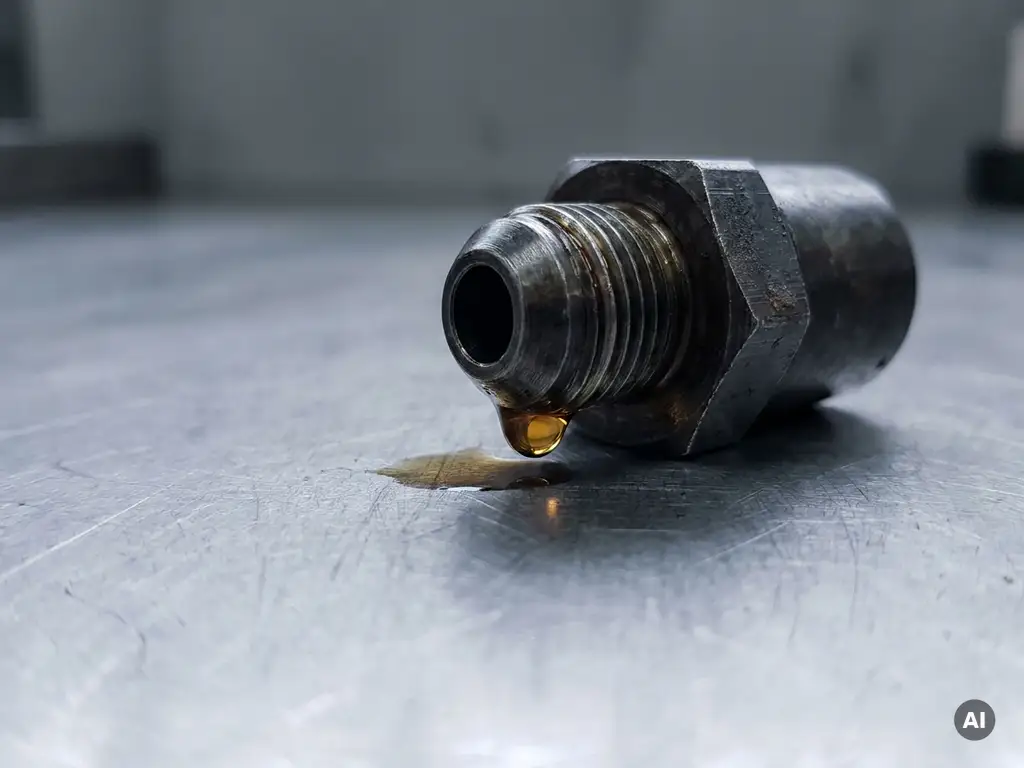
Hydraulic oil leaks occur when seals, fittings, hoses, or internal components fail to contain fluid under pressure. The most common causes are worn or damaged seals, loose connections, excessive system pressure, and component wear. Even a minor leak signals that something in the system has changed and deserves attention before it develops into a larger problem.
Hydraulic leakage is one of the most frequently reported issues in hydraulic systems across offshore, dredging, civil works, and industrial applications. Understanding what causes a leak, what it reveals about system condition, and when to act can help you prevent unplanned downtime and protect your equipment. The sections below address the most important questions maintenance engineers and asset managers face when dealing with hydraulic oil leaks.
What are the most common causes of hydraulic oil leaks?
The most common causes of hydraulic oil leaks are seal degradation, loose or damaged fittings, hose failure, corrosion, and excessive system pressure. Seals are the most frequent culprit because they are exposed to constant pressure cycling, temperature variation, and chemical interaction with hydraulic fluid over time.
In practice, leaks tend to originate from a limited set of failure points:
- Worn or hardened seals: Dynamic seals in hydraulic cylinders and actuators degrade through repeated compression and extension cycles. Over time, they lose elasticity and no longer form an effective barrier against pressurized fluid.
- Loose or improperly torqued fittings: Vibration in mobile equipment, offshore installations, and dredging vessels can gradually loosen hydraulic connections. Fittings that were not torqued to specification during assembly are especially vulnerable.
- Hose degradation: Hydraulic hoses have a finite service life. UV exposure, ozone, heat cycling, and mechanical abrasion cause the outer jacket and inner liner to deteriorate, leading to weeping or rupture.
- Corrosion: In marine and offshore environments, corrosion attacks exposed metal surfaces, pipe threads, and flange faces, creating leak paths that bypass sealing surfaces.
- Overpressure events: If system pressure exceeds the rated capacity of a component due to a faulty relief valve or incorrect pressure setting, seals and joints are forced beyond their design limits.
- Contaminated fluid: Hydraulic oil contaminated with water or particulates accelerates seal wear and corrodes internal surfaces, increasing the likelihood of leakage over time.
Identifying the root cause rather than simply replacing the leaking component is important. A seal that fails repeatedly after replacement is often a symptom of contamination, overpressure, or a misaligned cylinder rather than a standalone seal failure.
What does a hydraulic oil leak tell you about system health?
A hydraulic oil leak tells you that one or more components are no longer operating within their design parameters. The location, volume, and frequency of leakage provide specific diagnostic information about the condition of seals, pressure regulation, fluid quality, and structural integrity of the system.
Leaks should be read as condition indicators, not isolated events. A slow seep from a cylinder rod seal may indicate normal end-of-life wear on a high-cycle application. A sudden external leak at a fitting after years of stable operation may point to a recent overpressure spike or mechanical impact. Recurring leaks at the same location after repair suggest an underlying problem that the repair alone did not resolve.
From a system health perspective, leakage also affects fluid cleanliness. Every time a system loses oil and is topped up, there is a risk of introducing contamination if the replacement fluid is not filtered and handled correctly. Maintaining fluid cleanliness through hydraulische spoeling en filtratie is directly connected to reducing seal wear and extending the service life of pumps, valves, and actuators.
In high-stakes applications such as offshore lifting systems, active heave compensation, or hydraulic drive and control systems on dredging vessels, even a minor leak can indicate a shift in system behavior that warrants immediate investigation.
How can you tell if a hydraulic leak is internal or external?
An external hydraulic leak is visible as oil escaping from the system onto surfaces, the ground, or surrounding equipment. An internal leak occurs when fluid bypasses internal seals or valve seats within a component, moving from high-pressure to low-pressure areas without leaving the system. Internal leaks are not visible but cause measurable performance loss.
Signs of an external leak
External leaks are identified by oil residue on cylinder rods, wet spots on hose connections, staining around fittings, or pooling beneath equipment. They are straightforward to locate through visual inspection, especially when the system is pressurized and operating. UV dye injection can help pinpoint small external leaks that are difficult to trace by eye alone.
Signs of an internal leak
Internal leaks are harder to detect because the oil remains within the system. Common indicators include:
- A cylinder that drifts or fails to hold position under load, even when the control valve is closed
- Reduced actuator speed or force at the same pressure setting
- Elevated return line flow without a corresponding increase in work output
- Increased pump cycling frequency as the system compensates for bypassed fluid
- Rising fluid temperature due to energy dissipated as heat across leaking internal seals
Quantifying internal leakage requires flow measurement or cylinder drift testing under controlled load conditions. For hydraulic pumps and motors, volumetric efficiency testing during a revisie van hydraulische pompen en motoren can confirm whether internal bypass has exceeded acceptable limits.
What happens if hydraulic oil leaks go untreated?
Untreated hydraulic oil leaks lead to progressive system degradation, unplanned downtime, environmental contamination, and potential safety incidents. What begins as a minor seal weep can escalate into component failure, fluid loss below safe operating levels, and damage to surrounding equipment or structures.
The consequences develop in stages. In the short term, a small external leak increases fluid consumption and creates slip hazards on deck or in the workplace. As the leak worsens, the system may lose enough fluid to cause pump cavitation, which rapidly damages pump internals. In hydraulic cylinders, a deteriorating rod seal allows contamination to enter the cylinder bore, accelerating piston seal wear and scoring the cylinder wall.
Internal leaks left unaddressed cause a different set of problems. Bypassing fluid generates heat, which degrades oil viscosity and accelerates oxidation. Overheated hydraulic oil loses its lubrication properties, increasing wear across every component in the circuit. In systems with high-precision control requirements, such as hydraulic drive and control systems for offshore or civil applications, internal leakage introduces position errors and reduces controllability.
From an environmental and regulatory standpoint, hydraulic oil leaks on offshore platforms, vessels, and near waterways carry serious compliance implications. Spill containment and reporting obligations apply in most jurisdictions, and repeated leaks can trigger operational restrictions.
How do you find the source of a hydraulic oil leak?
Finding the source of a hydraulic oil leak requires a systematic inspection starting with the most likely failure points: cylinder rod seals, hose connections, valve block faces, and pipe fittings. Begin with a visual inspection under operating pressure, working from high-pressure to low-pressure sections of the circuit.
A structured approach to leak detection includes the following steps:
- Clean the system first: Wipe down all external surfaces before pressurizing. This removes existing oil residue and makes fresh leaks immediately visible.
- Pressurize and observe: Run the system through its normal operating cycle while inspecting connections, seals, and hoses. Pay attention to areas around dynamic seals and threaded connections.
- Use UV dye: For slow or intermittent leaks, adding UV-fluorescent dye to the hydraulic fluid and using an ultraviolet lamp makes small leak paths visible that are otherwise undetectable.
- Check return line flow: Elevated return flow at low or no load suggests internal bypass. Measuring flow at specific points in the circuit helps isolate which component is leaking internally.
- Inspect cylinder drift: Lock the control valve and apply a known load to the cylinder. Measure any position change over a defined period. Drift beyond the manufacturer’s specification confirms internal seal leakage.
- Analyze fluid samples: Oil analysis can reveal elevated metal particles consistent with internal wear, water ingress, or seal material breakdown, all of which correlate with leak locations.
In complex systems such as hydraulische systemen voor offshore wind, where multiple circuits operate simultaneously and access is restricted, systematic fault isolation using pressure gauges and flow meters at key circuit nodes is more efficient than random component replacement.
When should a hydraulic oil leak be repaired by a specialist?
A hydraulic oil leak should be repaired by a specialist when it involves high-pressure circuits, precision-engineered components, recurring failures after in-house repair attempts, or when the root cause is unclear. Attempting to repair complex hydraulic assemblies without the right tools, seals, and technical knowledge frequently results in repeat failures or additional damage.
Specific situations that require specialist involvement include:
- Cylinder overhaul: Replacing seals in a hydraulic cylinder requires correct disassembly, surface inspection of the bore and rod, seal selection matched to fluid type and operating pressure, and reassembly to precise tolerances. Incorrect seal fitting or a scored bore that is not addressed will cause the new seal to fail quickly.
- Pump and motor leakage: Internal leakage in hydraulic pumps and motors involves worn rotating groups, damaged shaft seals, and changes in clearance tolerances. This requires precision measurement and controlled reassembly conditions.
- High-pressure piping: Leaks in hydraulic piping systems operating above 250 bar require specialist welding, fitting replacement, and pressure testing to verify integrity before returning to service.
- Repeated seal failures: If seals fail repeatedly in the same location, a specialist is needed to investigate whether the root cause is contamination, misalignment, overpressure, or an incompatible seal material.
- Safety-critical systems: Any leakage in systems controlling lifting, load holding, or motion compensation on offshore platforms, cranes, or bridges should be assessed by qualified hydraulic engineers before the system returns to operation.
Delaying specialist repair to reduce short-term cost typically increases total repair cost and extends downtime. Early intervention limits damage to secondary components and reduces the risk of a controlled leak becoming an uncontrolled failure.
How HYCOM helps with hydraulic oil leaks and system repair
We support maintenance managers, engineers, and asset managers in diagnosing, repairing, and preventing hydraulic leakage across a wide range of industrial and offshore applications. Our technical teams work on complete hydraulic systems as well as individual components, with the expertise to identify root causes rather than address symptoms alone.
- Hydraulic cylinder overhaul: Full disassembly, bore and rod inspection, seal replacement with materials matched to operating conditions, and pressure testing before return to service.
- Pump and motor overhaul: Internal inspection, clearance measurement, rotating group replacement, and volumetric efficiency verification.
- Hydraulic piping and flushing: Inspection, replacement, and flushing of hydraulic piping systems to remove contamination and verify cleanliness to ISO cleanliness targets.
- System diagnostics: Pressure testing, flow measurement, and oil analysis to locate internal and external leaks and identify underlying causes.
- On-site and workshop service: MRO support from seven locations across the Netherlands, with more than 11,000 m² of workshop space and over 300 specialists available for planned and emergency repairs.
- Preventive maintenance programs: Structured inspection and maintenance schedules designed to identify early-stage seal wear and fluid degradation before leaks develop.
Wil je de betrouwbaarheid van je hydraulische systemen verbeteren, ongeplande stilstand beperken of een nieuwe hydraulische installatie ontwikkelen? Ontdek welke technische oplossingen en diensten aansluiten op jouw toepassing via ons overzicht van onderhoud en revisie van hydraulische systemen. We denken graag met je mee over een passende aanpak voor jouw project. Bespreek jouw hydraulische uitdaging met onze specialisten en laat ons meedenken over een oplossing die past bij jouw installatie en operationele eisen.