
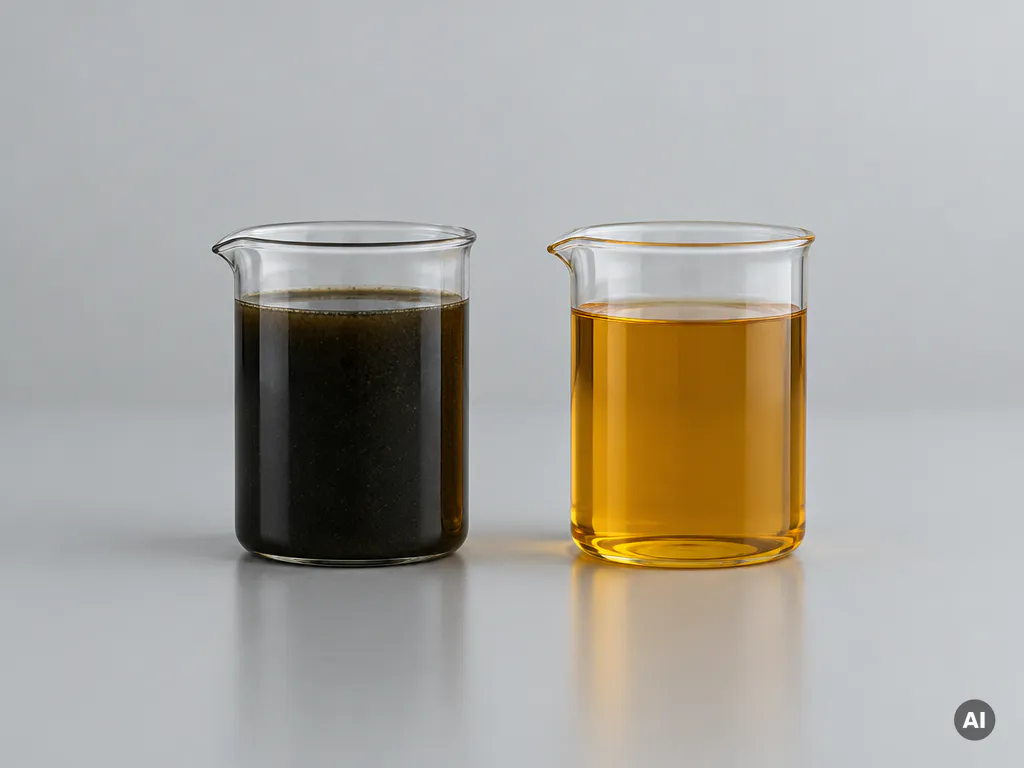
Oil turns dark and dirty because of oxidation, contamination or overheating, and dark oil is only a problem when it comes with particles, water, a burnt smell or a change in viscosity. In hydraulic systems, dark oil usually signals that wear debris, dust, water or degraded additives have built up in the fluid. Wait for an oil analysis before you decide, because colour alone is an unreliable indicator. Below we answer the most common questions about dirty hydraulic oil, from causes and diagnosis to hydraulic oil filtering and prevention.
Is dark oil always a sign of a problem?
No, dark oil is not always a problem. Oil darkens naturally as it ages and as additives and trace contaminants circulate through the system. Dark oil becomes a problem when it also contains particles or water, shows a burnt smell, or has lost viscosity or additive performance.
Some fluids and additive packages start out darker than others, and a clean system that has run for a long time will often show a gradual colour change. This is why a sudden change deserves more attention than a slow one. If the oil darkened within days or weeks, something has changed in the system: a seal failed, a component started wearing, or the oil overheated.
Treat colour as a prompt to investigate, not as a verdict. A visual check tells you when to take a sample. A laboratory analysis tells you what the sample actually contains.
What are the most common causes of dirty oil?
The most common causes of dirty hydraulic oil are particle contamination, water ingress, oxidation from heat, wear debris from components, and mixing of incompatible fluids. Most of these enter the system through poor filtration, worn seals, breathers or maintenance work.
Particle and water contamination
Dust, sand and fine debris enter through worn cylinder rod seals, unprotected breathers, open reservoirs and during maintenance. On offshore, dredging and civil works equipment, the environment adds salt, moisture and abrasive dirt. Water enters through condensation, leaking coolers and damaged seals, and it accelerates oxidation, corrosion and additive depletion.
Heat, oxidation and wear
Sustained high operating temperatures oxidise the oil, which darkens it and forms sludge and varnish. Overheating often points to an undersized cooler, a failing pump, internal leakage or an overloaded hydraulic power unit (HPU). Meanwhile, worn pumps, motors and hydraulic cylinders release metal particles that circulate and cause further wear, creating a cycle that gets worse over time.
What do different oil colours and smells mean?
Oil colour and smell give a quick first indication of the fluid’s condition. Milky oil suggests water, a burnt smell suggests overheating, dark and gritty oil suggests particle contamination, and a sour smell suggests oxidation. These signs guide further testing but do not replace it.
| Observation | Likely cause | Typical next step |
|---|---|---|
| Milky or cloudy | Water or air in the oil | Check seals, coolers and breathers; test water content |
| Dark with a burnt smell | Overheating and oxidation | Check cooler, pump efficiency and operating temperature |
| Dark and gritty | Particle contamination or wear debris | Run a particle count and inspect filters |
| Sour or acidic smell | Oxidation or additive breakdown | Test acidity and oil condition |
| Foamy | Air ingress or wrong fluid level | Check suction lines, fluid level and return lines |
| Metallic shimmer | Component wear | Analyse debris and inspect pumps and cylinders |
Combine several observations before drawing conclusions. A system can show more than one problem at the same time, such as water contamination that has also led to oxidation.
How can you check if your oil is still good?
The reliable way to check hydraulic oil is a laboratory oil analysis of a representative sample. It measures particle count (cleanliness class), water content, viscosity, acidity and wear metals. A visual and smell check supplements this but cannot confirm that the oil is fit for use.
Follow these steps for a useful result:
- Take the sample correctly. Sample from a running, warm system through a dedicated sampling point, using clean sample bottles, so you do not introduce contamination yourself.
- Compare against a baseline. Trends over time say more than a single measurement. Compare results with the new oil specification and earlier samples.
- Check against component requirements. Pumps, servo valves and proportional valves have different cleanliness requirements. Use the manufacturer’s specification and relevant ISO cleanliness codes as your reference.
- Set up condition monitoring. On critical installations, online particle counters and temperature monitoring help you detect changes before they cause damage.
For offshore, dredging and civil works equipment where unplanned downtime is expensive, a fixed sampling interval is a practical part of hydraulic maintenance.
What should you do when oil is already dirty?
When oil is already dirty, find and stop the source of contamination first, then clean the oil or replace it. Filtering or flushing without fixing the cause only delays the problem. Depending on the analysis, you filter, flush the system, change the oil or overhaul damaged components.
Work through these actions in order:
- Identify the source. Inspect rod seals, breathers, coolers, return line filters and recent maintenance activities for ingress points.
- Filter the oil. Offline filtration or kidney-loop filtering is an effective way to bring particle levels down when the oil itself has not degraded chemically.
- Flush the system. After a major failure, such as a pump breakdown that spread debris, flushing the pipework, manifolds and components removes particles that filters alone will not capture.
- Replace the oil when necessary. If oxidation, acidity or additive depletion is too high, filtering will not restore the fluid. Drain, flush and refill with the specified oil.
- Repair damaged components. Rising wear metals or repeated contamination often point to a worn pump, motor or cylinder. Timely hydraulic pump overhaul or hydraulic cylinder repair prevents secondary damage.
Check for external leakage as well. A hydraulic leak at a cylinder or fitting is often both a loss of oil and an entry point for dirt.
How can you keep oil clean for longer?
Keep hydraulic oil clean by controlling contamination at every entry point, using the right filtration, maintaining operating temperature and following a structured maintenance plan. Prevention costs less than recovery, and it extends the life of pumps, valves and cylinders.
Focus on these practical measures:
- Use proper filtration. Select filter ratings for the most sensitive component in your hydraulische aandrijf- en besturingssystemen and monitor filter clogging indicators.
- Fit quality breathers. Desiccant or filter breathers on the reservoir stop airborne dust and moisture from entering.
- Protect seals and rods. Replace worn wipers and rod seals on cylinders before dirt gets into the system, especially in marine and dredging environments.
- Control temperature. Keep the cooler clean and check that the fluid stays within its specified range.
- Handle oil cleanly. Filter new oil before filling the system with it, since new oil is not always clean enough for sensitive components. Use clean transfer equipment and keep connections capped.
- Plan regular maintenance. Combine scheduled oil sampling, filter changes and inspections of hoses, piping and seals. This is a core part of hydraulic maintenance and reduces unplanned downtime on critical installations. For reliable service in demanding sectors, see how MRO for hydraulic installations is structured.
Hoe HYCOM helpt bij het onderhoud van hydraulische installaties
Vervuilde of donkere olie is vaak het eerste signaal van een dieper probleem in het systeem. Wij helpen je om de oorzaak te vinden, de installatie weer schoon te krijgen en herhaling te voorkomen. Onze engineering- en productiefaciliteiten in Apeldoorn, Drachten en Enschede, aangevuld met MRO-werkplaatsen in Nederland, dekken het volledige traject van diagnose tot revisie.
- Onderhoud, revisie en reparatie van hydraulische componenten en systemen, waaronder hydraulische cilinders, pompen en motoren.
- Revisie van hydraulische cilinders en pompen en motoren wanneer slijtage de oorzaak van vervuiling is.
- Hydraulisch leidingwerk en het spoelen en reinigen van systemen na storingen of vervuiling.
- Optimalisatie van betrouwbaarheid, operationele prestaties en levensduur van je hydraulische installatie.
- Technische ondersteuning, installatie, inbedrijfstelling en service op locatie of in onze werkplaatsen.
Wil je de betrouwbaarheid van je hydraulische systemen verbeteren, ongeplande stilstand beperken of een nieuwe hydraulische installatie ontwikkelen? Ontdek welke technische oplossingen en diensten aansluiten op jouw toepassing, zoals hydraulische spoel- en filtratieoplossingen. We denken graag met je mee over een passende aanpak voor jouw project. Neem contact op en bespreek jouw hydraulische uitdaging met onze specialisten voor technisch advies of een projectbespreking.