
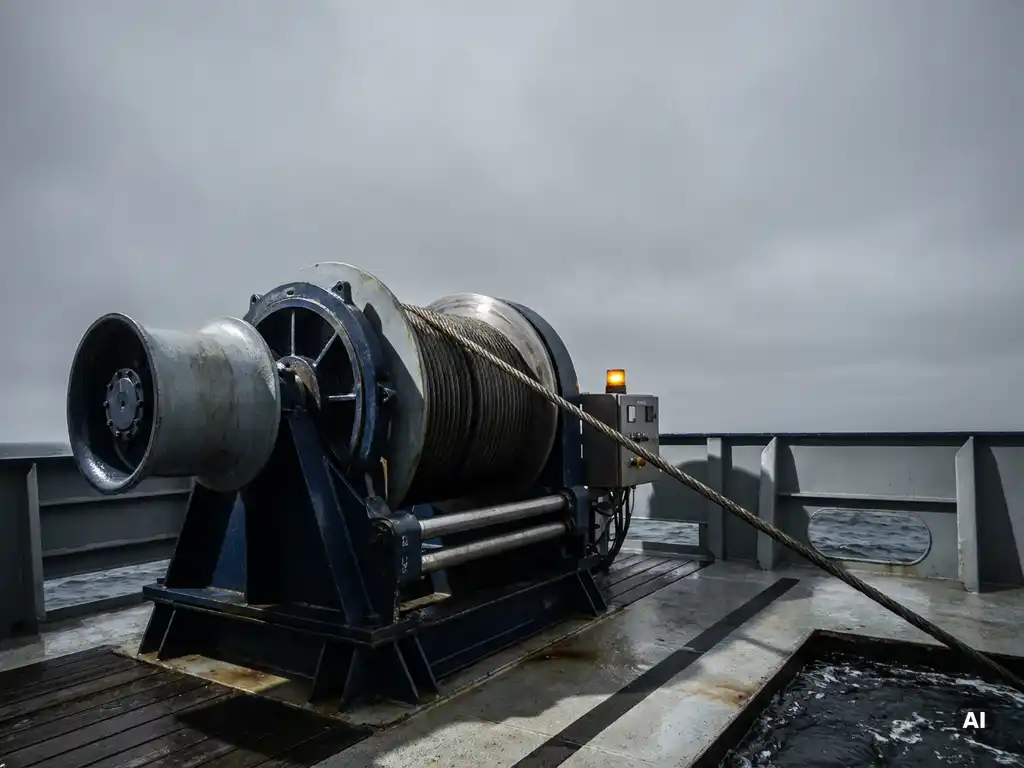
A hydraulic winch handles heavy loads at sea by using pressurised hydraulic fluid to generate high torque at low speed, giving it the pulling force needed to lift, lower, or tension loads that electric systems cannot match in demanding marine environments. The hydraulic power unit supplies a continuous flow of fluid to a hydraulic motor connected to the drum, and that motor converts fluid pressure directly into rotational force. The sections below cover how speed and tension are controlled, how the system responds to sudden load changes, how active heave compensation integrates with winch drives, and what maintenance and overhaul look like in practice.
What makes hydraulic power better for heavy marine lifting than electric?
Hydraulic power delivers a higher power-to-weight ratio than electric drive systems and sustains full torque across the entire speed range, including at zero speed. This makes it the preferred choice for heavy marine lifting where loads must be held stationary under tension without overheating the drive. In offshore conditions, where salt, spray, and shock loads are constant, a hydraulic motor also tolerates stall conditions that would damage an electric motor.
The core advantage comes from the hydraulic power unit (HPU), which separates the prime mover from the actuator. The HPU can be positioned away from the winch drum in a protected machinery space, while only the motor and drum assembly are exposed to the deck environment. This separation reduces the risk of electrical faults in wet or explosive-atmosphere zones and makes the system easier to maintain.
In offshore and dredging applications, the operating pressures typically range between 250 and 350 bar, producing the torque levels needed to handle anchor chains, mooring lines, and lifting wires on large vessels. Electric drives at equivalent torque require significantly larger and heavier motor assemblies, which creates problems on space-constrained offshore platforms and jack-up vessels.
How does a hydraulic winch control load speed and tension at sea?
A hydraulic winch controls load speed by varying the flow of hydraulic fluid to the drive motor and controls tension by regulating system pressure. A proportional directional control valve adjusts flow rate continuously, which changes drum speed in direct proportion. Pressure-relief valves set the maximum torque the motor can apply, which translates directly into line pull and tension limits.
More advanced winch systems use a closed-loop hydraulic circuit with a variable-displacement pump. The operator or control system adjusts the pump swashplate angle to increase or decrease flow without throttling through a valve, which improves energy efficiency and gives finer speed resolution. This is particularly relevant for constant-tension winch applications, where the drum must pay out or haul in automatically to maintain a set line tension regardless of vessel movement.
Constant-tension control is achieved by feeding a load-cell signal from the wire back into the hydraulic control system. When tension rises above the setpoint, the control system commands the pump to reduce pressure or allow the drum to pay out. When tension drops, it hauls in. This closed-loop tension management is a standard requirement in offshore mooring, pipe-laying, and crane tether applications.
What happens inside a hydraulic winch when the load suddenly increases?
When a load suddenly increases on a hydraulic winch, the system pressure rises immediately. If the pressure exceeds the relief valve setting, the relief valve opens and diverts flow back to the tank, preventing mechanical overload of the wire, drum, and structure. The drum stalls rather than breaking, which is the intended protective response of a well-sized marine hydraulic system.
In practice, a sudden load spike can come from wave-induced vessel motion, a snagged wire, or a dynamic shock during crane operations. The hydraulic circuit responds faster than any mechanical brake because fluid is incompressible at these timescales and the relief valve reacts in milliseconds. This is one of the reasons offshore hydraulic systems are preferred over mechanical or electric alternatives for shock-load environments.
A counterbalance valve is often fitted on the load-holding side of the motor circuit. This valve prevents the load from running away if a hose fails or if the control valve is accidentally opened. It holds the load in position until positive pilot pressure from the control circuit releases it in a controlled manner. Without a counterbalance valve, a hose failure on a loaded winch would result in uncontrolled drum rotation.
How does active heave compensation work with hydraulic winches?
Active heave compensation uses real-time motion data from the vessel to command the hydraulic winch drive to pay out or haul in wire at the same rate as the vessel heaves, keeping the suspended load stationary relative to the seabed or a fixed reference point. The hydraulic power unit must respond fast enough to track wave frequencies, which typically requires a high-response proportional or servo valve and a variable-displacement pump.
The motion reference unit measures vessel heave acceleration and velocity. A motion controller converts this signal into a flow demand that is sent to the hydraulic drive. The winch motor then accelerates or decelerates the drum in the opposite direction to the vessel movement, cancelling the heave effect on the wire. In active systems, the hydraulic circuit must absorb the regenerative energy produced when the drum is driven by the load during the downward vessel stroke.
We design active heave compensation systems, including the HeaveCom system, which recovers this regenerative energy hydraulically rather than dissipating it as heat. This approach delivers significant energy savings compared to systems that simply dump the regenerated flow across a relief valve. For offshore operations involving subsea installation, ROV handling, or crane work in open sea conditions, active heave compensation integrated into a hydraulic winch drive is the standard technical solution. You can find more detail on how we apply this in our hydraulic systems for offshore wind applications.
What are the main failure points of a hydraulic winch in marine conditions?
The main failure points of a hydraulic winch in marine conditions are seal degradation, contamination of the hydraulic fluid, corrosion of external components, and wear in the hydraulic motor and brake assembly. Each of these failure modes is accelerated by the salt, humidity, temperature cycling, and mechanical vibration present on offshore vessels and platforms.
Seal and fluid contamination failures
Shaft seals on the hydraulic motor and drum bearings are the first components to degrade in a marine environment. Salt water ingress past a worn shaft seal contaminates the hydraulic fluid, which then circulates through the entire system and accelerates wear in pumps, valves, and motors. Fluid contamination is the leading cause of premature component failure in offshore hydraulic power units. Regular fluid sampling and particle count analysis are the most reliable early-warning tools.
Brake and counterbalance valve failures
The holding brake on a hydraulic winch is a spring-applied, hydraulically-released disc brake. The brake springs fatigue over time, and the friction discs wear. If the brake does not fully release, the drum generates heat and the friction material degrades rapidly. If the brake does not fully engage, the load drifts under tension. Counterbalance valves can also stick or drift in their pressure settings due to contamination, leading to either uncontrolled lowering or excessive back-pressure that wastes energy.
When should a hydraulic winch be overhauled rather than repaired?
A hydraulic winch should be overhauled rather than repaired when multiple components show wear simultaneously, when the root cause of repeated failures is systemic contamination or corrosion throughout the circuit, or when the cost of repeated repairs over a 12-month period approaches the cost of a full overhaul. Repair addresses a single failed component; overhaul restores the entire assembly to a known condition.
Practical indicators that point toward overhaul include internal leakage across the motor that exceeds the manufacturer’s specification, brake disc thickness below the minimum wear limit, hydraulic fluid that fails particle count analysis despite recent changes, and corrosion on the manifold block or valve bodies that affects sealing surfaces. When any three of these conditions are present together, continuing to repair individual components becomes less cost-effective than a planned overhaul.
For vessels and platforms operating under class society requirements, overhaul intervals may also be defined by the classification rules for the equipment. In those cases, the decision is not purely economic but also a compliance requirement. Scheduling an overhaul during a planned drydocking or maintenance window avoids unplanned downtime during operations. The hydraulic drive and control systems on a winch should be assessed as a complete circuit during overhaul planning, not component by component in isolation.
How we support hydraulic winch systems for offshore applications
We design, engineer, and build complete hydraulic winch drive systems for offshore, dredging, and offshore wind applications, from the HPU and control architecture through to the motor assembly, brake circuit, and counterbalance valves. Our scope covers both new builds and upgrades to existing winch installations.
- Engineering and development of hydraulic winch drive and control systems, including constant-tension and active heave compensation circuits.
- Design and production of offshore hydraulic power units, manifold blocks, and custom HPU configurations for deck and machinery-space installation.
- Overhaul and repair of hydraulic motors, brake assemblies, control valves, and complete winch circuits at our workshop facilities across the Netherlands.
- Fluid contamination analysis and condition monitoring to identify deterioration before it results in unplanned downtime.
- On-site installation, commissioning, and technical support for hydraulic winch systems on offshore vessels and platforms worldwide.
Want to improve the reliability of your hydraulic winch systems, reduce unplanned downtime, or develop a new hydraulic installation for offshore operations? Explore our hydraulic pump and motor overhaul or discuss your hydraulic challenge with our specialists. We think through the right technical approach with you for your specific project and operating conditions.