
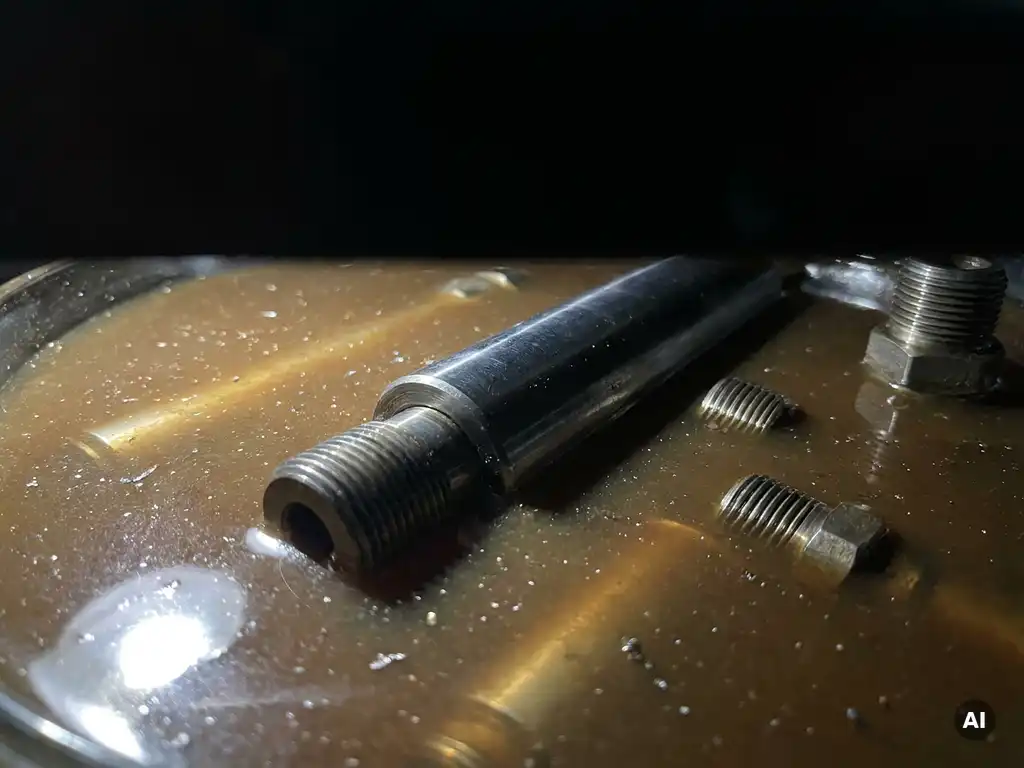
Dirty hydraulic fluid is the leading cause of hydraulic system failures. Contamination, whether from particles, water, or air, accelerates wear on pumps, valves, cylinders, and seals, reducing system efficiency and shortening component lifespan. The sections below answer the most important questions about hydraulic fluid contamination, from how it develops to how you can control it.
What happens inside a hydraulic system when fluid becomes contaminated?
When hydraulic fluid becomes contaminated, abrasive particles circulate through the system and erode precision-machined surfaces inside pumps, motors, control valves, and cylinders. This wear generates additional particles, creating a self-reinforcing cycle that accelerates damage. Even small particles, invisible to the naked eye, can cause significant damage because the internal clearances in hydraulic components are often just a few micrometres wide.
The consequences show up in several ways. Spool valves start to stick or leak internally, causing erratic or sluggish machine response. Pump efficiency drops as internal clearances increase, which means higher energy consumption for the same output. Seals degrade faster, leading to hydraulieklekkage both internally and externally. In active heave compensation systems, winch drives, and other dynamic hydraulic applications, this kind of degradation directly affects positioning accuracy and load control.
Left unaddressed, contamination shifts from a maintenance issue to a reliability risk. Unplanned breakdowns in offshore, dredging, or civil works environments carry significant operational and safety consequences.
What are the most common sources of hydraulic fluid contamination?
The most common sources of hydraulic fluid contamination are built-in contamination from manufacturing, ingressed contamination from the environment, and internally generated contamination from component wear. Understanding each source helps you target the right preventive measures.
Built-in contamination
New hydraulic systems often contain residual contamination from manufacturing and assembly: metal swarf, pipe scale, welding slag, and thread sealant particles. This is why flushing a new or overhauled system before commissioning is a standard requirement, not an optional step.
Ingressed contamination
Particles and water enter the system through cylinder rod seals, breather caps, and reservoir access points. In offshore and dredging environments, where equipment operates in wet, dusty, or corrosive conditions, ingression rates are significantly higher than in controlled industrial settings. Damaged or worn seals accelerate this process.
Internally generated contamination
Every hydraulic component generates wear particles during normal operation. Pumps, motors, and cylinders all shed microscopic metal particles over time. The rate of generation increases as components age or operate under high load cycles. This is why regular hydraulische olie filteren is not just a startup precaution but a continuous operational requirement.
How does water contamination damage hydraulic systems differently than particles?
Water contamination damages hydraulic systems through a different mechanism than solid particles. Rather than causing direct abrasion, water accelerates corrosion on metal surfaces, degrades the lubricating properties of the fluid, and promotes the growth of microbial organisms that further break down the oil. Even concentrations as low as 0.1% water in hydraulic fluid can have measurable effects on system reliability.
Water enters hydraulic systems through condensation in reservoirs, contaminated new oil, damaged shaft seals, or heat exchanger leaks. In offshore and marine environments, seawater ingress is a particularly serious risk because saltwater is far more corrosive than fresh water.
The practical effects include rust and pitting on cylinder bores and valve surfaces, reduced film strength that leads to metal-to-metal contact, and emulsification of the oil that clogs filters and reduces flow. In systems with servo valves or proportional valves, common in hydraulische systemen voor offshore wind, even trace water contamination can cause valve spool corrosion that disrupts precise control.
Detecting water early through oil sampling allows you to address the source before corrosion damage becomes irreversible.
What ISO cleanliness code should hydraulic fluid meet?
The ISO cleanliness code a hydraulic system requires depends on the sensitivity of its components. The ISO 4406 standard classifies fluid cleanliness by counting particles per millilitre at three size thresholds: 4 µm, 6 µm, and 14 µm. A typical target for systems with servo valves or proportional valves is ISO 16/14/11 or cleaner. Systems with less sensitive components, such as basic directional valves and cylinders, may operate acceptably at ISO 18/16/13.
Higher-precision systems demand cleaner fluid because tighter internal clearances make them more vulnerable to particle-induced wear. As a general rule:
- Servo and proportional valve systems: ISO 16/14/11 or cleaner
- Directional and pressure control valve systems: ISO 17/15/12 to ISO 18/16/13
- General hydraulic systems with cylinders and gear pumps: ISO 19/17/14 to ISO 20/18/15
Component manufacturers typically specify the required cleanliness level in their documentation. Always use their specification as the baseline, and design your filtration system to maintain that level under worst-case operating conditions. The hydraulische aandrijf- en besturingssystemen we engineer are designed with filtration specifications matched to the sensitivity of the installed components.
How can hydraulic fluid contamination be detected before damage occurs?
Hydraulic fluid contamination can be detected before damage occurs through regular oil sampling and analysis, particle counting, and online condition monitoring. The earlier contamination is identified, the more options you have to intervene without unplanned downtime or component replacement.
Laboratory oil analysis
Sending oil samples to a laboratory gives you a detailed picture of contamination levels, wear metal concentrations, water content, and fluid degradation. Wear metal analysis, measuring the concentration of iron, copper, aluminium, and other metals, reveals which components are generating abnormal wear particles and allows targeted inspection before failure occurs. This is a standard tool in any structured hydrauliekservice programme.
Particle counters and online monitoring
Portable particle counters allow on-site measurement of ISO cleanliness levels without sending samples to a lab. For critical systems, such as HPUs on offshore platforms or active heave compensation systems, inline particle counters provide continuous monitoring and can trigger alarms when contamination exceeds acceptable limits. This approach supports condition-based maintenance and reduces the risk of operating a system in a degraded state.
Combining periodic laboratory analysis with online monitoring gives the most complete view of system health and lets you schedule hydrauliekreparatie or filter changes at the right time rather than reactively.
What is the most effective way to control hydraulic fluid cleanliness?
The most effective way to control hydraulic fluid cleanliness is a layered approach that combines proper filtration, controlled fluid handling, regular oil analysis, and disciplined maintenance practices. No single measure is sufficient on its own; contamination control requires consistent application across the entire system lifecycle.
Key measures include:
- Select the right filter rating for the application. Use filters with a beta ratio matched to the required ISO cleanliness level. High-pressure filters on pump outlets, return-line filters, and kidney-loop filtration units each address different contamination pathways.
- Flush new and overhauled systems before commissioning. Flushing removes built-in contamination that would otherwise circulate through the system from the first moment of operation. This is particularly important after hydraulische cilinderreparatie or hydraulische pomprevisie, where machining debris may be present.
- Protect the reservoir. Fit breather filters with a micron rating consistent with the system’s cleanliness target. Seal reservoir access points and inspect them regularly.
- Handle new oil correctly. New hydraulic oil from the drum is not necessarily clean enough for sensitive systems. Filter all incoming oil before adding it to the reservoir.
- Monitor and replace filters on condition. Use differential pressure indicators or sensors to detect when filters are loaded, rather than replacing them on a fixed time interval that may not reflect actual operating conditions.
- Conduct regular oil sampling. Establish a sampling schedule based on system criticality and use the results to adjust maintenance intervals. For more on managing hydraulic system health, see our approach to hydraulische spoel- en filtratieoplossingen.
In demanding environments such as offshore platforms, dredging vessels, and civil infrastructure, where access for unplanned maintenance is difficult or costly, investing in robust filtration and monitoring from the design phase pays back quickly in reduced downtime and longer component life.
Hoe HYCOM helpt bij het beheersen van hydraulische vloeistofkwaliteit
Wij ondersteunen technisch directeuren, maintenancemanagers en engineers bij het beheersen van hydraulische vloeistofkwaliteit, van systeemontwerp tot revisie en doorlopende service. Onze aanpak sluit aan op de eisen van offshore, baggeren, civiele werken en industriële toepassingen, waar betrouwbaarheid en beschikbaarheid direct invloed hebben op operationele prestaties.
- Engineering van hydraulische aandrijf- en besturingssystemen met geïntegreerde filtratie afgestemd op de vereiste ISO-reinheidsklasse.
- Spoelen van nieuwe en gereviseerde systemen voor inbedrijfstelling, inclusief documentatie van behaalde reinheidsklassen.
- Revisie van hydraulische cilinders, pompen en motoren: hydraulische cilinderrevisie en hydraulische pomprevisie worden uitgevoerd in onze werkplaatsen met gecontroleerde reinheidsomstandigheden.
- MRO-diensten gericht op het verlengen van de levensduur van hydraulische systemen en het beperken van ongeplande stilstand.
- Technische ondersteuning en conditiebewaking voor kritieke hydraulische installaties in offshore, baggeren en civiele infrastructuur.
Wil je de betrouwbaarheid van je hydraulische systemen verbeteren, ongeplande stilstand beperken of een nieuwe hydraulische installatie ontwikkelen? Ontdek welke technische oplossingen en diensten aansluiten op jouw toepassing via onze hydraulische spoel- en filtratieoplossingen. We denken graag met je mee over een passende aanpak voor jouw project. Bespreek jouw hydraulische uitdaging met onze specialisten en laat ons meedenken over een technisch onderbouwde oplossing.