
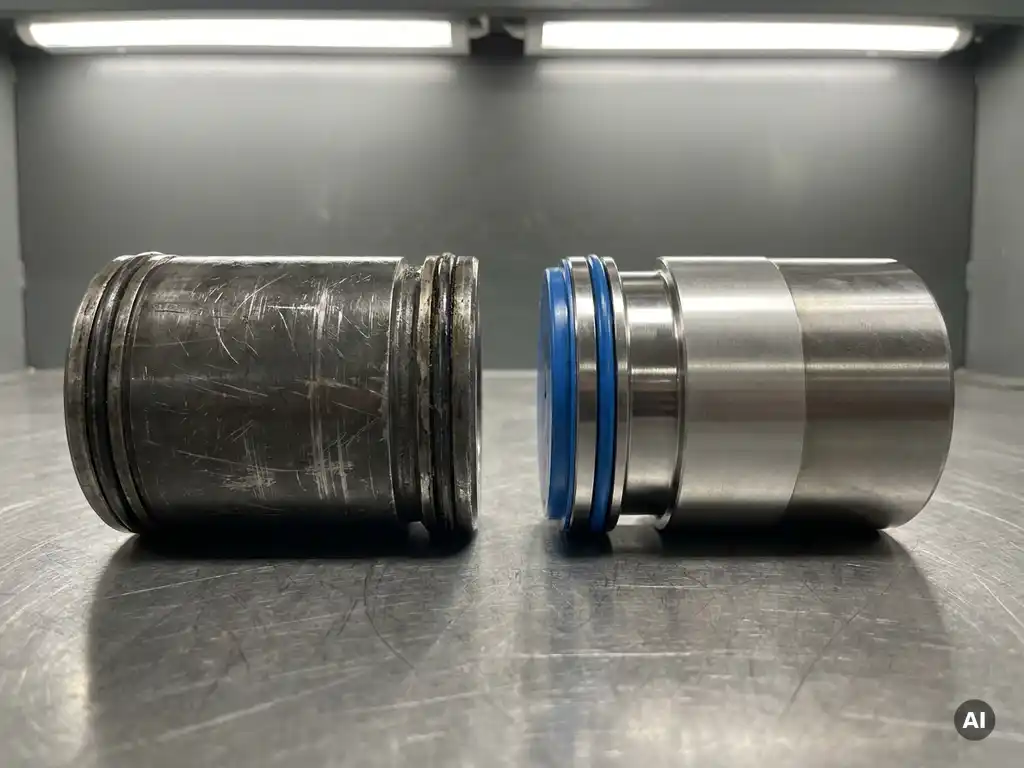
Repairing a hydraulic component means fixing a specific, identified fault while keeping the original parts in place wherever possible. Rebuilding means disassembling the component completely, replacing all wear parts and seals, and restoring it to a defined performance standard. The right choice depends on the nature of the fault, the age of the component, and the operational demands placed on the system.
For maintenance managers and engineers working in offshore, dredging, civil works, or industrial environments, getting this decision right directly affects uptime, cost, and long-term reliability. The sections below answer the most common questions about hydraulic repair versus rebuild in practical, technical terms.
What actually happens during a hydraulic component repair?
A hydraulic component repair targets a specific, diagnosed fault without fully disassembling the component. The technician identifies the failure mode, replaces or restores only the affected parts, and returns the component to working condition. This approach is appropriate when the fault is isolated and the surrounding parts show no significant wear or damage.
In practice, a repair might involve replacing a single seal that has caused hydraulieklekkage, reseating a valve that is not closing correctly, or replacing a worn port fitting. The component is tested after the intervention to confirm it meets the required pressure and flow specifications.
The key characteristic of a repair is its scope: it is targeted rather than comprehensive. This makes it faster and less expensive than a full rebuild, but it also means that other wear conditions within the same component are not addressed. If the component has accumulated significant service hours or shows general wear across multiple internal surfaces, a repair may resolve the immediate symptom without eliminating the underlying deterioration.
What does rebuilding a hydraulic component involve?
Rebuilding a hydraulic component involves complete disassembly, thorough inspection of every internal part, replacement of all seals and wear elements, and reassembly to manufacturer or engineering specifications. The goal is to restore the component to a defined performance standard, not just to fix a single fault.
During a rebuild, a technician will typically:
- Disassemble the component fully and clean all parts
- Measure and inspect internal surfaces for scoring, erosion, or dimensional wear
- Replace all seals, O-rings, and dynamic sealing elements as a complete set
- Replace worn or damaged internal components such as pistons, valve spools, or bearing surfaces
- Reassemble to specified torque values and clearances
- Test under load to verify pressure rating, flow capacity, and leak-tightness
Hydraulische cilinderrevisie and hydraulische pomprevisie are both rebuild processes in this sense. They restore not just function but the internal geometry and sealing integrity that determine long-term reliability. A properly executed rebuild brings the component back to a state that is comparable to new manufacture in terms of performance, even if the housing and structural parts are original.
For hydraulische aandrijf- en besturingssystemen operating in demanding environments such as offshore platforms or dredging vessels, rebuild procedures are typically governed by documented work instructions and subject to quality inspection at each stage.
When should you repair rather than rebuild a hydraulic component?
Repair is the right choice when the fault is clearly isolated, the component has relatively low service hours, and inspection confirms that internal wear is within acceptable limits. If a single seal has failed due to contamination or a fitting has been damaged mechanically, a targeted repair is both faster and more cost-effective than a full rebuild.
Repair is also appropriate when a system cannot be taken out of service for an extended period. In time-critical operations, such as a dredging campaign or a civil works project with a fixed completion date, a fast repair that restores function may be preferable to a rebuild that requires the component to be removed and sent to a workshop for several days.
However, repair should only be chosen after a proper diagnosis. Replacing a leaking seal without understanding why it failed, for example, risks a repeat failure within a short interval. A competent hydrauliekservice team will always investigate the root cause before deciding whether a repair is sufficient or whether a rebuild is the more reliable path.
When does a hydraulic component need a full rebuild instead?
A full rebuild is warranted when the component shows general internal wear, has accumulated significant service hours, has experienced a major failure event such as internal contamination or cavitation, or when inspection reveals that multiple internal surfaces or elements are outside tolerance. In these cases, a targeted repair will not restore reliable long-term performance.
Specific indicators that point toward a rebuild include:
- Reduced output pressure or flow that cannot be explained by a single fault
- Repeated seal failures in a short period, suggesting internal surface damage
- Visible scoring on cylinder bores, pump barrels, or valve spools
- Contaminated hydraulic oil that has circulated through the component for an extended period
- A component that has reached or exceeded its recommended service interval
- A failure event involving overpressure, water ingress, or severe contamination
In offshore and dredging applications, where hydraulisch onderhoud en revisie is planned as part of a broader maintenance strategy, rebuilds are often scheduled proactively based on operating hours rather than waiting for a failure to occur. This approach reduces the risk of unplanned downtime and allows the work to be planned around operational schedules.
How do repair and rebuild differ in cost and downtime?
A repair is generally less expensive and faster than a rebuild in the short term. A targeted repair on a hydraulic cylinder or valve block may take hours rather than days, and the parts cost is limited to the specific elements being replaced. A full rebuild involves more labor, a complete seal kit, and potentially replacement of internal components, making it more expensive upfront.
However, the total cost picture is more complex. A repair that does not address underlying wear may result in a repeat failure within months, leading to additional repair costs, emergency call-out charges, and unplanned production loss. When you factor in the cost of unplanned downtime in an offshore or dredging context, a rebuild that prevents a second failure often has a lower total cost of ownership than a sequence of short-interval repairs.
The relevant comparison is not repair cost versus rebuild cost in isolation, but rather the expected service life and reliability that each option delivers relative to the operational context. A component that is rebuilt correctly and tested to specification should deliver a predictable service interval, which makes maintenance planning more straightforward.
Does a rebuilt hydraulic component perform like a new one?
A correctly rebuilt hydraulic component can match the performance specification of a new component. When all seals are replaced, worn internal surfaces are restored or replaced, and the unit is reassembled and tested to the original engineering specification, the functional output in terms of pressure, flow, and leak-tightness should meet the same standard as a new part.
The structural housing, cylinder barrel, or pump body of a rebuilt component is typically the original part, provided it is within dimensional tolerance. This is not a disadvantage: hydraulic housings are designed for long service life and rarely need replacement if the component has been maintained correctly and has not suffered impact damage or severe corrosion.
What determines whether a rebuild delivers new-equivalent performance is the quality of the process: the accuracy of the inspection, the quality of the replacement parts, the skill of the technician, and the rigor of the final testing. A rebuild carried out to a documented procedure, using specified seal kits and measured against defined performance criteria, is a reliable restoration method. For critical components in hydraulische systemen voor offshore wind or other demanding applications, this level of process discipline is not optional.
One practical consideration: a rebuilt component should be accompanied by documentation of what was inspected, what was replaced, and what performance was confirmed during testing. This supports traceability and gives the maintenance team a clear baseline for the next service interval.
How HYCOM helps with hydraulic component repair and rebuild
We carry out hydraulic component repair and rebuild for a wide range of industries, including offshore, dredging, civil works, and industrial applications. Our approach combines technical diagnosis, documented work procedures, and performance testing to make sure every component we return to service meets the required specification.
- Hydraulische cilinderrevisie: Complete disassembly, inspection, and rebuild of hydraulic cylinders, including dimensional measurement of bores and rods, seal replacement, and pressure testing.
- Pomp- en motoroverhaul: Full rebuild of hydraulic pumps and motors to restore rated pressure and flow performance, with documented inspection results and test records.
- Diagnose en reparatie: Targeted fault diagnosis and repair for isolated failures, including seal replacements, valve servicing, and hydraulic leakage repair.
- Hydraulisch leidingwerk en filtratie: Where contamination has contributed to component wear, we address root causes including hydraulische olie filteren and flushing to prevent repeat failures.
- MRO-planning en ondersteuning: We support maintenance managers in planning rebuild intervals based on operating hours and condition monitoring data, reducing the risk of unplanned downtime.
Wil je de betrouwbaarheid van je hydraulische systemen verbeteren, ongeplande stilstand beperken of een nieuwe hydraulische installatie ontwikkelen? Ontdek welke technische oplossingen en diensten aansluiten op jouw toepassing via onze pagina over revisie van hydraulische pompen en motoren, of bespreek jouw hydraulische uitdaging met onze specialisten. We denken graag met je mee over een passende aanpak voor jouw project.