
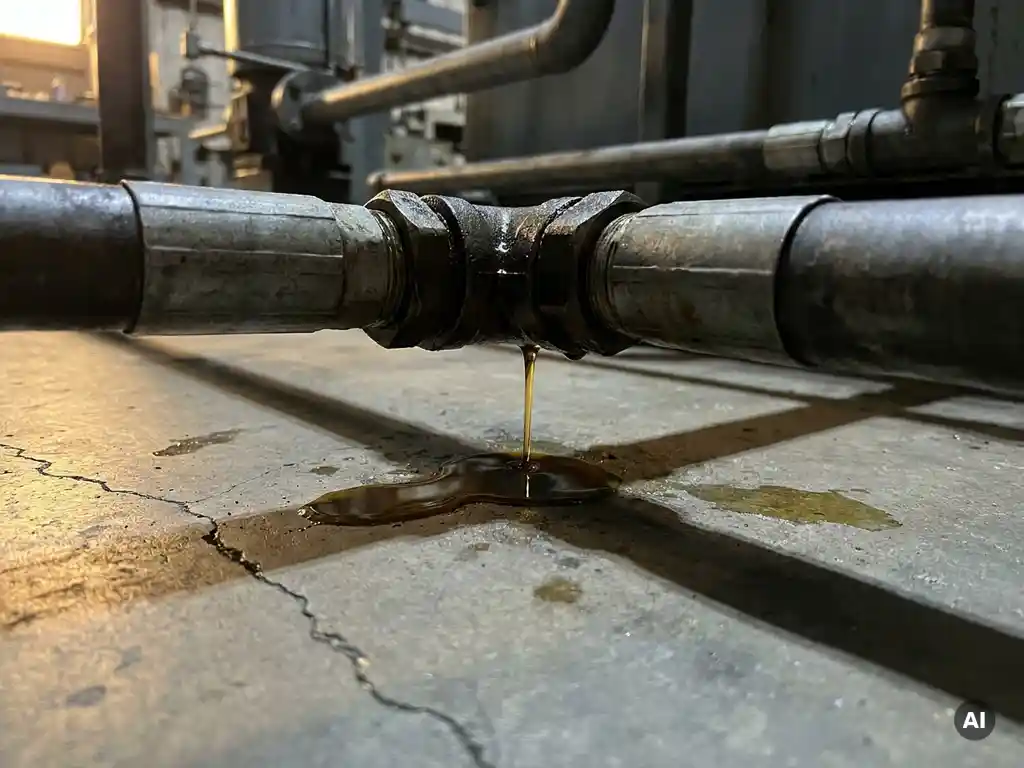
Ignoring a slow hydraulic leak will make the problem worse, not stabilize it. Fluid loss reduces system pressure, accelerates component wear, and creates safety and environmental risks that grow over time. What starts as a minor seep around a fitting or cylinder rod can develop into a full system failure if left unaddressed. The sections below answer the most common questions about what actually happens when a hydraulic leak goes untreated.
How quickly does a slow hydraulic leak get worse?
A slow hydraulic leak rarely stays slow. The rate of deterioration depends on the source, but most leaks accelerate because the conditions that caused them (worn seals, micro-cracks, loose fittings, or surface corrosion) continue to degrade under operating pressure and thermal cycling. Within weeks or months, a minor seep can become a visible drip, and a visible drip can become a flow that empties a reservoir during a single shift.
The mechanism is straightforward: as a seal degrades, the contact area that maintains pressure integrity shrinks. Hydraulic fluid carries particulate contamination, and as it passes through the compromised point, it erodes the sealing surface further. On cylinder rods, this creates a feedback loop where scoring on the rod surface damages the wiper and rod seal on every stroke, accelerating fluid loss with each operating cycle.
Temperature also plays a role. Hydraulic fluid expands and contracts with heat, and seals that hold under cold start conditions may weep under operating temperature. Over time, the thermal cycling fatigues the seal material, and the leak window widens. In offshore, dredging, and civil works applications where equipment runs continuously under high load, this progression can happen faster than maintenance intervals allow.
What damage can a slow hydraulic leak cause to system components?
A slow hydraulic leak damages system components in two ways: through fluid loss that causes cavitation and pressure instability, and through contamination ingress at the leak point that degrades fluid quality across the entire system. Both mechanisms cause wear that extends well beyond the original leak location.
When fluid level drops, the hydraulic pump begins drawing in air. This causes cavitation, which generates pressure spikes that erode pump internals, damage valve seats, and stress hydraulic lines. A pump running with insufficient fluid also runs hotter, which degrades the fluid viscosity and accelerates oxidation of the remaining oil.
At the same time, a leak point is also an ingress point. Dirt, water, and atmospheric contamination enter the system through the same gap that fluid escapes from. Contaminated fluid carries abrasive particles through the system, increasing wear rates on cylinder bores, valve spools, and pump components. This is why hydraulic oil filtration and condition monitoring are important even when a leak appears minor. A system that has been seeping for months may have fluid that is far outside the acceptable contamination class, requiring a full flush and filter replacement before the leak repair delivers any lasting benefit.
For hydraulic cylinders specifically, a leaking rod seal allows fluid to bypass the piston, reducing effective force output and causing uneven movement. In applications such as active heave compensation systems or hydraulic drive and control systems on dredging vessels, this loss of precision has direct operational consequences.
Why is hydraulic fluid loss dangerous beyond the machine itself?
Hydraulic fluid loss creates risks that extend beyond mechanical damage. The two primary concerns are fire hazard and environmental contamination. Hydraulic oil is flammable, and a fine mist or spray from a pressurized leak point can ignite on contact with hot surfaces, exhaust manifolds, or electrical components. In enclosed spaces such as engine rooms on offshore vessels or plant rooms in industrial facilities, this risk is significant.
Environmental contamination is a serious and often regulated concern. Hydraulic fluid that reaches soil, waterways, or the sea is classified as a pollutant in most jurisdictions. For operators working in offshore, dredging, or civil works environments, an uncontrolled leak can trigger regulatory reporting requirements, operational shutdowns, and cleanup costs that far exceed the cost of the repair itself.
On deck or in work areas, leaked hydraulic fluid creates slip hazards that put personnel at risk. In cold weather environments, this is compounded by the fluid freezing on walking surfaces. These safety considerations make hydraulic leakage a maintenance priority that sits outside the normal cost-versus-risk calculation for mechanical wear.
How does a hydraulic leak affect system performance and efficiency?
A hydraulic leak reduces system performance by lowering the available pressure and flow that the pump can maintain at the actuator. Even a small continuous leak means the pump must work harder to compensate for lost volume, increasing energy consumption, heat generation, and pump wear simultaneously. The system becomes less responsive, and cycle times increase.
In systems with load-holding functions, such as hydraulic cylinders supporting a static load on a jack-up platform or a lock gate in a civil works application, internal or external leakage causes the load to drift. This drift requires the system to re-pressurize repeatedly, which adds unnecessary pump cycles and accelerates wear across the entire hydraulic power unit.
Fluid temperature rises when a leak is present because the pump is generating heat to maintain pressure against a system that is not retaining it. Elevated fluid temperature degrades viscosity, reduces lubrication film thickness on moving components, and shortens the service life of seals throughout the system, not just at the leak point. The result is a system that consumes more energy, delivers less output, and wears out faster, all from a leak that may have appeared minor at the outset.
For operators managing hydraulische systemen voor baggerschepen, where continuous high-load operation is standard, even a moderate reduction in system efficiency translates directly into reduced production output and higher operating costs over a campaign.
What are the signs that a slow hydraulic leak has reached a critical stage?
A slow hydraulic leak has reached a critical stage when it begins affecting system function, not just fluid level. The key indicators are visible fluid accumulation that requires frequent top-up, measurable pressure loss during operation, actuator drift under load, and abnormal pump noise or heat. Any one of these signals that the leak is no longer a minor maintenance item.
More specific warning signs include:
- Reservoir level dropping between scheduled checks, indicating fluid loss that exceeds normal consumption
- Pump cavitation noise, a high-pitched whine or knocking sound that indicates the pump is drawing air
- Actuator drift or slow response, where cylinders or motors no longer hold position or reach target speed
- Elevated fluid temperature without a corresponding increase in ambient temperature or load
- Contaminated fluid, visible as discoloration, cloudiness, or a change in smell, indicating water ingress or oxidation
- Visible scoring on cylinder rods, which indicates the rod seal has been compromised and the rod surface is being damaged on every stroke
In well-maintained hydraulische aandrijf- en besturingssystemen, condition monitoring data such as pressure trend logging, fluid sample analysis, and temperature tracking can flag these changes before they become visible. Without monitoring in place, operators often only identify critical leaks when performance has already deteriorated significantly.
When should a hydraulic leak be repaired rather than monitored?
A hydraulic leak should be repaired as soon as it is confirmed, not monitored indefinitely. Monitoring is only appropriate for a very short window, specifically to determine the source and rate of leakage before scheduling the repair. Any leak that is causing fluid loss, affecting performance, creating a fire or environmental risk, or showing signs of progression requires repair, not observation.
The decision to monitor versus repair is sometimes framed as a cost question, but the actual cost comparison favors early repair in almost every case. Seal replacement and cylinder servicing cost a fraction of what a pump overhaul, full system flush, or unplanned shutdown costs. In offshore or dredging operations, the cost of lost operational time typically exceeds the repair cost many times over.
There are specific conditions that make immediate repair non-negotiable:
- The leak is near a heat source or electrical installation, creating a fire risk
- Fluid is reaching the environment, triggering regulatory obligations
- The leak is on a load-bearing cylinder or a safety-critical actuator
- Fluid level requires topping up more than once per shift
- System performance has measurably degraded
For leaks on hydraulic cylinders, the repair typically involves replacing rod seals, wipers, and piston seals, and inspecting the rod and bore for scoring. If surface damage is present, a full revisie van hydraulische pompen en motoren or cylinder overhaul is the appropriate response rather than a seal-only replacement that will fail again on a damaged surface.
Hoe HYCOM helpt bij hydraulisch lekkagebeheer en onderhoud
Wij ondersteunen operators in de offshore, baggerij, civiele techniek en industrie bij het voorkomen, diagnosticeren en verhelpen van hydraulische lekkage. Onze aanpak richt zich op het hele systeem, niet alleen op het lek zelf.
- Revisie en reparatie van hydraulische cilinders, inclusief inspectie van staafoppervlakken, boring en afdichtingsvlakken
- Pomp- en motoroverhaul, waarbij slijtage als gevolg van cavitatie of verontreinigde hydraulische olie wordt hersteld
- Hydraulisch spoelen en filtreren, om na een lek de vloeistofkwaliteit terug te brengen naar de vereiste contaminatieklasse
- Onderhoud en inspectie van hydraulisch leidingwerk en manifolds, inclusief het opsporen van verborgen lekpunten
- Conditiemonitoring en preventief onderhoud, om lekkage vroegtijdig te signaleren en ongeplande stilstand te beperken
- Engineering van volledige hydraulische aandrijf- en besturingssystemen wanneer systeemvervanging of uitbreiding nodig is
Wil je de betrouwbaarheid van je hydraulische systemen verbeteren, ongeplande stilstand beperken of een nieuwe hydraulische installatie ontwikkelen? Ontdek welke technische oplossingen en diensten aansluiten op jouw toepassing via onderhoud en revisie van hydraulische systemen. We denken graag met je mee over een passende aanpak voor jouw project. Bespreek jouw hydraulische uitdaging met onze specialisten en we kijken samen naar de meest effectieve aanpak voor jouw situatie.