
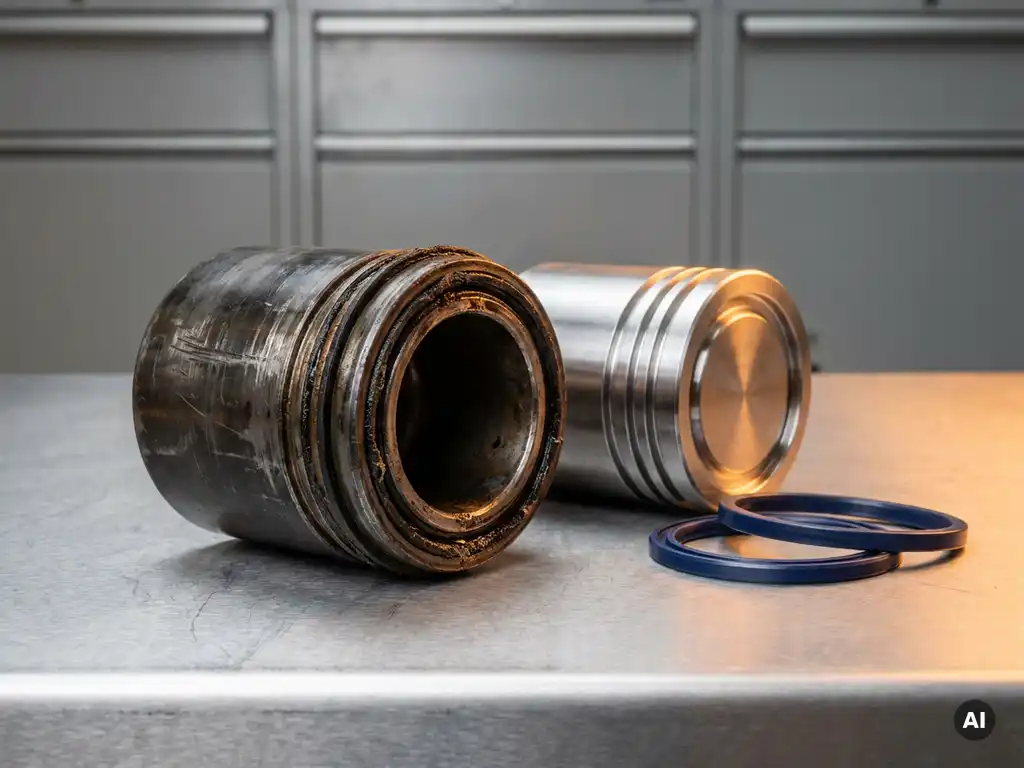
Stop repairing a hydraulic part and replace it when repair costs exceed roughly 50 to 60 percent of the replacement cost, when the component has reached structural wear limits, or when repeated failures signal that the root cause cannot be addressed through repair alone. For maintenance managers and engineers working with hydraulic systems in offshore, dredging, civil works, or industrial applications, the repair-or-replace decision directly affects system reliability, safety, and total cost of ownership. The questions below break down the key factors that should drive that decision.
What are the signs that a hydraulic component is beyond repair?
A hydraulic component is beyond repair when it shows structural damage that cannot be corrected without compromising its rated performance, when internal wear has exceeded manufacturer tolerances, or when sealing surfaces are so degraded that reliable sealing is no longer achievable. Hydraulieklekkage that persists after multiple seal replacements is one of the clearest indicators that the underlying geometry is no longer within spec.
Specific warning signs include:
- Scoring or deep grooves on cylinder bores or rod surfaces that exceed honing tolerances and cannot be remachined within dimensional limits
- Cracks in cylinder barrels, manifold blocks, or pump housings that affect structural integrity under operating pressure
- Severe pitting or corrosion on sealing surfaces, valve seats, or bearing journals
- Worn or damaged splines and shaft interfaces on hydraulic pumps and motors that affect torque transmission
- Recurring internal bypass in hydraulic cylinders, indicating that the bore and piston clearance has grown beyond what new seals can compensate for
When any of these conditions are present, continuing to repair the component typically results in shortened intervals between failures and higher cumulative maintenance costs. A thorough inspection during hydraulische cilinderrevisie or pomprevisie will determine whether critical dimensions are still within tolerance before a repair decision is made.
How do repair costs compare to replacement costs for hydraulic parts?
As a general industry guideline, repair becomes economically questionable when the total repair cost, including labour, parts, downtime, and logistics, approaches or exceeds 50 to 60 percent of the cost of a new or remanufactured replacement. Below that threshold, repair is usually the more cost-effective choice, especially for large custom components where replacement lead times are long.
The comparison is rarely straightforward. Several factors shift the balance:
- Component size and customisation: Large hydraulic cylinders for dredging or offshore applications are often custom-engineered, making replacement expensive and slow. Repair is frequently the better economic choice, provided the component is structurally sound.
- Availability of spare parts: If a pump or motor model is discontinued, sourcing OEM-equivalent components for repair can cost more than a modern replacement unit.
- Labour and workshop access: Hydrauliekreparatie on large or complex assemblies requires specialist tooling and expertise. If that capability is not available locally, transport and workshop costs can push repair costs above the replacement threshold quickly.
- Residual service life after repair: A repaired component that delivers only 30 to 40 percent of its original service life before the next intervention may be more expensive over time than a replacement that runs for the full maintenance cycle.
Total cost of ownership, not just the immediate invoice, should drive the comparison. Factor in the probability of repeat failure, the cost of the associated downtime, and the remaining service life of the broader system.
How many times can a hydraulic cylinder be repaired before replacement is necessary?
There is no fixed number of repairs after which a hydraulic cylinder must be replaced. The determining factor is whether the cylinder’s structural dimensions and surface conditions still fall within the tolerances required for reliable sealing and load-bearing performance. A well-maintained cylinder in a controlled industrial environment may be overhauled several times over decades; a cylinder exposed to abrasive or corrosive conditions may reach its limits after one or two interventions.
Each hydraulische cilinderrevisie should include a dimensional inspection of the bore, rod, and end cap interfaces. The key measurements are:
- Bore diameter and surface finish after honing
- Rod diameter, straightness, and chrome layer thickness
- Thread and port condition on end caps and mounting interfaces
- Wall thickness of the barrel, particularly if corrosion is present
If the bore can still be honed to within tolerance and the rod can be re-chromed or replaced, the cylinder body itself has remaining life. Once the barrel wall is too thin to hone further, or the rod has been re-chromed to its maximum diameter allowance, replacement of those sub-components or the complete cylinder becomes necessary. Keeping accurate repair records across the service history of each cylinder makes this assessment straightforward.
Does the age of a hydraulic system affect the repair-or-replace decision?
Yes, the age of a hydraulic system is a relevant factor, but it is not the deciding one on its own. Age matters because it affects parts availability, the cumulative fatigue state of structural components, and the compatibility of repaired components with the rest of the system. A hydraulic system that is 20 or 25 years old may still be fully serviceable if it has been maintained correctly and its components remain within dimensional tolerances.
Where age becomes a stronger argument for replacement is when it is combined with other risk factors:
- Obsolete components: Older hydraulic power units (HPUs) may use pump or valve models that are no longer manufactured, making hydraulische pomprevisie dependent on remanufactured parts with uncertain quality.
- Accumulated fatigue in structural parts: High-cycle applications such as active heave compensation systems or dredge pump drives accumulate significant fatigue loading. Beyond a certain service life, structural components should be inspected or replaced regardless of visible condition.
- System-wide efficiency losses: Older hydraulic systems often operate with less efficient components than current designs. If a major component needs replacement, it may be worth evaluating whether upgrading the broader system delivers a better return than maintaining ageing technology.
Age should be assessed alongside condition data and operational history, not used as a standalone threshold. Our hydraulische aandrijf- en besturingssystemen are designed for long service lives, but regular condition monitoring is what determines whether a system remains fit for purpose at any age.
What role does application criticality play in choosing repair or replacement?
Application criticality has a direct influence on the repair-or-replace threshold. For hydraulic components in safety-critical or high-availability applications, such as offshore jack-up systems, lock gates, or dredge cutter drives, the acceptable risk of a post-repair failure is much lower than in a non-critical industrial application. Higher criticality shifts the decision toward replacement or full overhaul at lower wear levels.
Consider two scenarios:
- A hydraulic cylinder on a secondary clamping system in a manufacturing line fails. The cost of unplanned downtime is measured in hours and the safety risk is low. Repair is likely the right call even if the cylinder is showing moderate wear.
- A hydraulic cylinder on the spud system of a dredging vessel or on a bridge lock gate fails mid-operation. The downtime cost is measured in days, the safety and contractual implications are significant, and the consequences of a repeat failure are severe. In this context, replacing the component with a new or fully remanufactured unit is the more defensible decision, even if repair is technically possible.
Maintenance managers working on hydraulische systemen voor baggerschepen or offshore platforms should define criticality classifications for all hydraulic components in their system and use those classifications to set differentiated repair-or-replace thresholds rather than applying a single rule across the entire installation.
When should a hydraulic part be replaced as part of planned maintenance rather than after failure?
A hydraulic part should be replaced proactively when condition monitoring data, service history, or manufacturer guidance indicates that the probability of failure within the next maintenance interval is unacceptably high. Planned replacement is preferable to run-to-failure in any application where unplanned downtime is costly, safety-critical, or operationally disruptive.
Proactive replacement is particularly appropriate in these situations:
- Seals and wear elements with defined service lives: Hydraulic seals, filter elements, and accumulator bladders have predictable wear cycles. Replacing them on a fixed interval during planned maintenance shutdowns prevents in-service leakage and contamination-related damage.
- Components approaching known fatigue limits: In high-cycle applications, components such as cylinder rods, piston rods, and pump shafts accumulate fatigue damage. Replacing them before they reach the end of their calculated fatigue life eliminates the risk of sudden structural failure.
- Condition monitoring signals: Rising particle counts in hydraulic oil samples, increasing bypass flow in cylinders, or vibration signatures in pump and motor diagnostics all indicate degradation before failure occurs. Acting on these signals during a scheduled maintenance window avoids unplanned shutdowns.
- Opportunity maintenance during major overhauls: When a system is already taken offline for a planned overhaul, replacing components that are at 70 to 80 percent of their expected service life is more cost-effective than scheduling a separate intervention six months later.
A structured hydraulic maintenance programme that combines fixed-interval replacement schedules with condition-based monitoring gives maintenance teams the information they need to make timely, evidence-based decisions rather than reacting to failures after they occur.
Hoe HYCOM helpt bij hydraulische reparatie en vervanging
We ondersteunen maintenance managers, engineers en asset managers bij het nemen van goed onderbouwde beslissingen over reparatie, revisie en vervanging van hydraulische componenten en systemen. Onze technische expertise en werkplaatscapaciteit zijn direct beschikbaar voor zowel urgente storingen als planmatige onderhoudstrajecten.
- Revisie van hydraulische cilinders: Dimensionele inspectie, herboring, herverchromen van stangen en volledige montage met nieuwe afdichtingen en eindcontrole op druk en lekkage.
- Pomp- en motoroverhaul: Volledige demontage, meting en revisie van hydraulische pompen en motoren, inclusief beoordeling van de resterende levensduur en advies over vervanging bij overschrijding van toleranties.
- Hydraulisch leidingwerk en HPU-onderhoud: Inspectie, reiniging en herstel van hydraulische krachtpakketten, manifolds en leidingwerk als onderdeel van planmatig onderhoud of na storingen.
- Conditiebewaking en vloeistofanalyse: Ondersteuning bij het opzetten van monitoringprogramma’s op basis van deeltjestelling en olieanalyse om degradatie vroegtijdig te signaleren.
- Technisch advies over repair-or-replace: Onafhankelijke beoordeling van de technische en economische afweging tussen reparatie en vervanging, gebaseerd op inspectiebevindingen en operationele context.
Wil je de betrouwbaarheid van je hydraulische systemen verbeteren, ongeplande stilstand beperken of een nieuwe hydraulische installatie ontwikkelen? Ontdek welke technische oplossingen en diensten aansluiten op jouw toepassing via onze pagina over onderhoud en revisie van hydraulische systemen. We denken graag met je mee over een passende aanpak voor jouw project. Bespreek jouw hydraulische uitdaging met onze specialisten voor technisch advies of een concrete projectbespreking.