
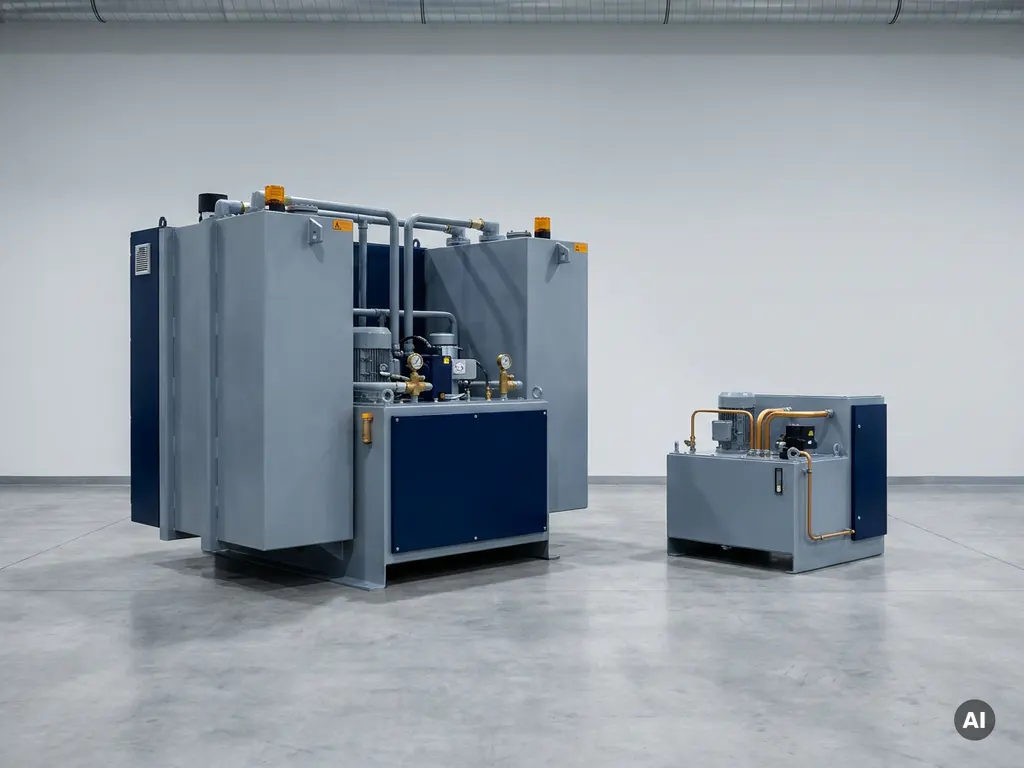
A hydraulic power unit (HPU) and a hydraulic power pack are the same thing in functional terms. Both describe a self-contained assembly that generates, conditions, and delivers pressurised hydraulic fluid to actuators such as cylinders, motors, or valves. The two terms are used interchangeably across the industry, and the choice between them is almost always a matter of regional convention or company preference rather than any technical distinction.
That said, subtle differences in how the terms are applied do exist in practice, particularly when it comes to scale, application context, and procurement language. The sections below unpack where each term comes from, what these systems contain, and when the naming choice actually matters.
Are a hydraulic power unit and a power pack the same thing?
Yes, a hydraulic power unit and a hydraulic power pack refer to the same type of system. Both consist of a prime mover (typically an electric motor or combustion engine), a hydraulic pump, a reservoir, filtration, and control valves assembled into a single unit that supplies pressurised fluid to a hydraulic circuit. There is no standardised technical definition that separates the two terms.
In everyday engineering and procurement practice, the terms appear side by side in datasheets, tender documents, and supplier catalogues without any implied difference in specification or capability. A project engineer specifying an offshore hydraulic system for a jack-up platform might write “HPU” throughout the design documentation, while a colleague sourcing a compact unit for a mobile application might call the same type of device a “power pack.” Both descriptions point to the same category of equipment.
Where confusion occasionally arises is in cross-border projects, where different national industries have developed their own preferred vocabulary. Understanding that the underlying technology is identical helps teams avoid misalignment during the design and procurement phases.
Where does each term come from?
The term hydraulic power unit became dominant in heavy industrial and offshore engineering environments, particularly in English-speaking markets such as the United Kingdom, the United States, and the Netherlands. The word “unit” signals a complete, engineered assembly that forms a defined part of a larger system, which suited the language of large-scale plant engineering and offshore project documentation.
The term power pack has stronger roots in mobile equipment, compact industrial machinery, and European manufacturing traditions. It carries a connotation of compactness and portability, which is why it remains common in contexts such as construction equipment, agricultural machinery, and smaller workshop installations.
Over time, both terms migrated across sectors. The offshore and dredging industries, for example, use “HPU” almost universally in engineering drawings and functional specifications, while the same manufacturers may label a compact version of the same product a “power pack” in their commercial catalogues. Neither term is formally defined by ISO, IEC, or other major hydraulic standards bodies, which is why both have remained in parallel use without one displacing the other.
What are the main components inside an HPU or power pack?
Regardless of which term is used, the internal architecture of a hydraulic power unit or power pack follows the same fundamental layout. The core components are a prime mover, a hydraulic pump, a fluid reservoir, filtration equipment, heat management, and a control and monitoring system.
- Prime mover: An electric motor is the most common choice for fixed industrial and offshore installations. Diesel or petrol engines are used where grid power is unavailable, as in mobile or remote applications.
- Hydraulic pump: Converts mechanical energy into flow. Gear pumps, vane pumps, and axial piston pumps are all used depending on the required pressure, flow rate, and efficiency level.
- Reservoir: Stores hydraulic fluid, allows entrained air to separate, and provides a thermal buffer. Reservoir size is matched to system flow demand and heat dissipation requirements.
- Filtration: Suction strainers, pressure filters, and return-line filters maintain fluid cleanliness to the ISO 4406 cleanliness class specified for the system. Fluid filtration quality directly affects component life and system reliability.
- Heat exchanger or cooler: Controls fluid temperature within the operating range. In offshore and marine applications, seawater coolers are commonly integrated.
- Control valves and manifolds: Regulate pressure, flow direction, and actuator sequencing. In advanced systems, proportional or servo valves enable precise motion control.
- Instrumentation and monitoring: Pressure transducers, temperature sensors, flow meters, and level switches feed data to a control panel or PLC for condition monitoring and safety interlocking.
For demanding applications such as hydraulic systems for offshore wind installations, the HPU must also accommodate redundancy requirements, corrosion-resistant materials, and compliance with classification society rules. These design requirements shape the physical configuration significantly, even though the fundamental component list remains the same.
When does size or application change how the term is used?
In practice, “power pack” tends to describe smaller, more compact units, while “HPU” is more commonly applied to larger, engineered systems built for continuous industrial or offshore duty. This is a convention rather than a rule, but it is consistent enough to be worth understanding when reading specifications or supplier documentation.
A compact power pack for a hydraulic winch on a service vessel might deliver 30 to 50 bar with a modest flow rate, housed in a single enclosure that can be moved by a forklift. An offshore hydraulic power unit for a jack-up leg system or an active heave compensation system, by contrast, may occupy a dedicated equipment room, operate at pressures above 300 bar, and include multiple redundant pump sets with automated switchover logic.
Application context also influences terminology. In hydraulic drive and control systems for dredging vessels, offshore platforms, and civil infrastructure such as bridges and locks, the term HPU is standard because these systems are engineered to project-specific requirements and integrated into larger control architectures. In mobile plant, rental equipment, and smaller workshop machinery, “power pack” remains the more natural description.
Marine and offshore classification societies, including DNV, Lloyd’s Register, and Bureau Veritas, use “hydraulic power unit” in their rule sets and type approval documentation, which reinforces the term’s dominance in regulated offshore and marine engineering environments.
Does the name affect how a system is specified or purchased?
The name itself does not affect technical specification, but using inconsistent terminology within a project can create unnecessary confusion during tendering, engineering reviews, and equipment handover. When a tender document uses “power pack” and a supplier responds with an “HPU” datasheet, both parties need to confirm they are discussing the same scope before proceeding.
For procurement teams and project engineers, the practical advice is straightforward: define the term you intend to use in the project’s functional specification and apply it consistently. Whether you call it a hydraulic power unit or a power pack, the specification should cover the same parameters regardless of the label.
- Operating pressure range (minimum, nominal, and maximum in bar)
- Flow rate (litres per minute at rated speed)
- Fluid cleanliness class (ISO 4406 target cleanliness level)
- Operating temperature range and cooling method
- Prime mover type, power rating, and supply voltage
- Redundancy requirements (single pump, duplex, or triplex configuration)
- Control interface (manual, PLC, or remote monitoring)
- Applicable standards and classification society requirements
- Environmental conditions (ATEX zone, offshore corrosion protection, ambient temperature)
Specifying these parameters precisely eliminates ambiguity regardless of which name appears on the purchase order. In offshore and dredging projects, where lead times are long and design changes are costly, clear specification language is more valuable than consistent use of any single term.
How Hycom designs and delivers hydraulic power units
We engineer and build complete hydraulic power units and power packs for some of the most demanding applications in the offshore, dredging, civil works, and industrial sectors. Our scope covers the full development cycle, from initial concept and hydraulic system design through to manufacturing, factory acceptance testing, installation, and commissioning.
- Engineering and development of hydraulic drive and control systems tailored to project-specific pressure, flow, and redundancy requirements.
- Design and production of HPUs for offshore applications, including jack-up platforms, active heave compensation systems, and hydraulic winch drives.
- Integration of advanced electronic control systems, condition monitoring, and safety interlocking into HPU assemblies.
- Hydraulic piping, manifold design, and fluid filtration solutions matched to the cleanliness requirements of each application.
- Maintenance, overhaul, and repair of hydraulic power units and associated components to extend operational life and reduce unplanned downtime.
- Technical support, on-site commissioning, and long-term service agreements for offshore and marine hydraulic installations.
Wil je de betrouwbaarheid van je hydraulische systemen verbeteren, ongeplande stilstand beperken of een nieuwe hydraulische installatie ontwikkelen? Ontdek welke technische oplossingen en diensten aansluiten op jouw toepassing via onze pagina over hydraulische systemen en maatwerkoplossingen of neem direct contact op om jouw hydraulische uitdaging te bespreken met onze specialisten. We denken graag met je mee over een passende aanpak voor jouw project.