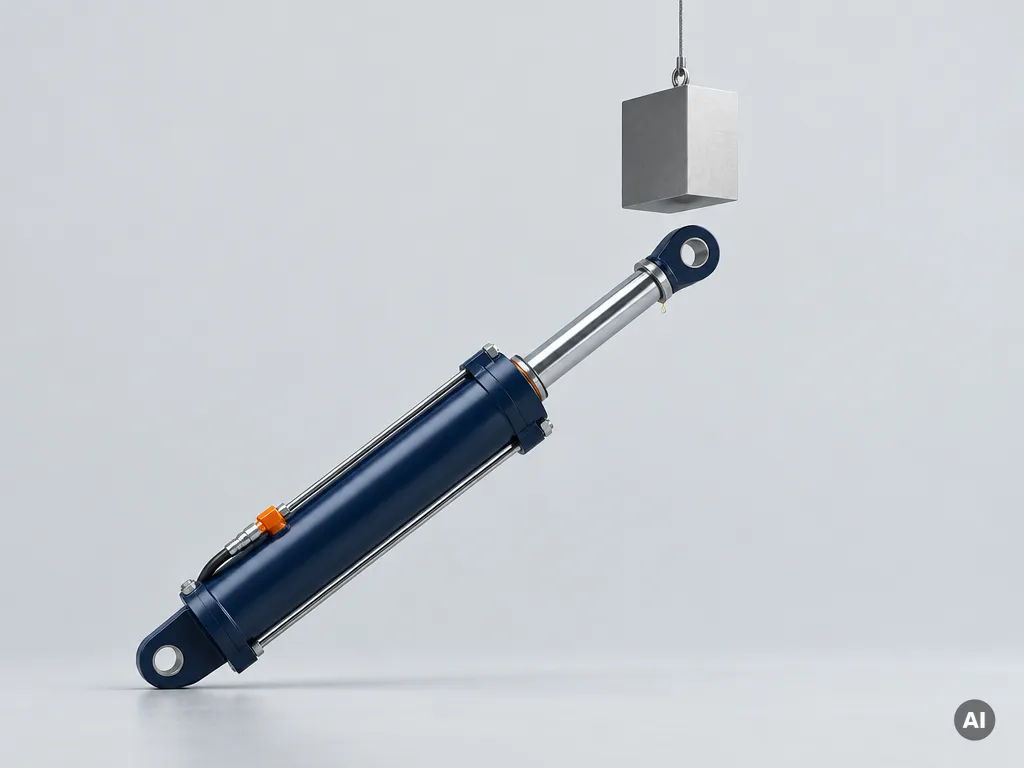
Machines move unevenly under heavy loads mainly because the hydraulic system cannot deliver a steady flow and pressure to the actuator. Typical causes are air or contaminated oil, worn seals and cylinders, pump or valve faults, poorly tuned controls and an unevenly distributed load. Each of these gets worse as load increases. The sections below explain how to recognise and separate them in offshore, dredging and civil works equipment.
## Why Does Jerky Movement Only Show Up Under Load?
Jerky movement appears under load because high pressure exposes weaknesses that stay hidden at light duty. Small internal leakage, trapped air, slight friction or marginal control response become visible once the system must hold or move a heavy mass. Under load, flow demand and pressure both rise, so any instability grows into visible stick-slip motion.
Three mechanisms explain most cases:
– **Stick-slip friction:** a cylinder or guide alternates between sticking and sliding when the driving force barely exceeds static friction.
– **Compressibility effects:** air or a flexible hose lets the system store and release energy, which makes the load surge.
– **Pressure drops:** undersized lines, restrictive filters or a weak pump let pressure dip as demand rises.
A useful first check is to compare behaviour with and without load, and at different speeds. If the jerking disappears at higher speed, friction or air is a likely cause. If it gets worse at higher speed, look at flow capacity and valve response.
## Can Air or Contaminated Oil Cause Uneven Lifting?
Yes. Air in the oil and contaminated fluid are two of the most common causes of uneven lifting. Air compresses under pressure and then expands, so the cylinder moves in surges instead of smoothly. Particles, water and degraded oil disturb valve operation and increase wear, which also produces erratic motion.
**Air** usually enters through suction line leaks, a low reservoir level, poorly bled cylinders or worn pump shaft seals. Typical signs include foamy oil, a spongy feel, unusual noise from the pump and movement that smooths out after the system has run for a while.
**Contamination** is harder to see. Fine particles can make spool valves stick or respond slowly, which creates stepwise motion. Water reduces the lubricating properties of the oil and promotes corrosion. In marine and offshore environments, moisture ingress is a particular risk.
Practical measures include:
– Check the oil level and look for foaming or discolouration.
– Take an oil sample and review the particle count and water content.
– Inspect suction lines and fittings for air leaks.
– Review filter condition and the filtration setup.
Good fluid filtration and regular condition monitoring prevent many of these faults before they affect lifting performance. For severely contaminated systems, hydraulic flushing restores the required cleanliness.
## How Do Worn Seals and Cylinders Affect Smooth Movement?
Worn seals and cylinders cause uneven movement because they allow internal leakage and increase friction. When oil bypasses the piston seal, the cylinder cannot hold pressure steadily, so it drifts, hesitates or lifts at an uneven speed. Scored rods or barrels add friction that triggers stick-slip.
Typical wear patterns include:
– **Piston seal wear:** pressure leaks from one chamber to the other, which causes slow lifting, load drift and heat build-up.
– **Rod seal damage:** external oil leakage and air ingress on the return stroke.
– **Scored rod or barrel surface:** localised friction that makes the cylinder judder at specific stroke positions.
– **Worn guide bands:** side loading and misalignment inside the cylinder.
If the jerk always occurs at the same point in the stroke, mechanical damage to the rod or barrel is more likely than a control issue. A simple drift test, where the cylinder holds a load while you watch for movement, helps confirm internal leakage. A hydraulic cylinder overhaul that includes new seals, honing or rod repair usually restores smooth motion and extends service life.
## What Role Do Pumps, Valves and Controls Play?
Pumps, valves and controls determine how smoothly flow and pressure reach the actuator. A worn pump delivers inconsistent flow, a sticking valve reacts late or unevenly, and poorly tuned control settings create oscillation. Any of these can make a machine lift unevenly, especially when the load changes quickly.
### Pump and Power Unit Issues
A worn pump loses volumetric efficiency, so flow drops as pressure rises. In a hydraulic power unit (HPU), this shows up as slow lifting and pressure fluctuations under load. Cavitation caused by restricted suction lines creates noise and pulsating flow. Check case drain flow, inlet conditions and pump response under load.
### Valve and Control Issues
Proportional and servo valves depend on clean oil and correct calibration. Contamination, worn spools or drifting amplifier settings lead to hunting and uneven motion. Relief valve chatter, wrongly set counterbalance valves and poorly tuned PID parameters also cause oscillation. In electronic control systems, a faulty feedback sensor or unstable signal can create jerky movement even when the hydraulics are in good condition.
For winch systems, constant tension winches and active heave compensation, control tuning matters even more. These systems must react continuously to changing loads, so any lag or instability appears directly in the motion.
## How Can Uneven Load Distribution Cause Shaking?
Uneven load distribution causes shaking because one cylinder, drive or lifting point carries more force than the others. This leads to pressure differences, unequal speeds and mechanical twisting. In multi-cylinder lifting systems, the unbalanced force creates racking, vibration and sudden corrections by the control system.
Common causes are:
– An off-centre load or a shifting centre of gravity.
– Cylinders with different amounts of internal leakage or friction.
– Unequal oil flow to parallel actuators, for example from mismatched flow dividers.
– Mechanical wear in guides, pins or structural connections.
Applications such as jacking systems on self-elevating platforms, bridge lifts and lock gates depend on synchronised movement across several lifting points. Here, flow control, position feedback and regular alignment checks keep the structure level. If one corner lags or leads, check the cylinder condition and the flow distribution before you adjust the control settings.
## When Should an Uneven Lift Be Inspected by a Specialist?
An uneven lift should be inspected by a specialist when the problem repeats, gets worse over time, or affects safety and load control. Pressure loss, load drift, overheating, unusual noise and visible leakage are clear warning signs. Do not keep operating equipment that cannot hold a suspended load reliably.
Bring in a specialist when:
– Basic checks of oil level, filters and visible leaks do not resolve the problem.
– The load drifts down while holding position.
– The system shows repeated pressure spikes, temperature rise or alarm codes.
– The equipment is critical to your operation and downtime is costly.
– Several possible causes interact, for example worn components combined with contaminated oil.
A structured diagnosis measures pressure, flow, temperature and oil cleanliness, then checks the cylinders, valves and control signals one by one. This approach identifies the root cause instead of treating symptoms, and it prevents repeated failures. Reviewing the entire installation, including [hydraulic systems for offshore wind](https://hycom.nl/hydraulic-systems-for-offshore-wind/) and similar demanding applications, helps you see whether the fault is isolated or part of a wider reliability issue. Well-designed [hydraulic drive and control systems](https://hycom.nl/hydraulic-systems/) also include measurement points that make this diagnosis faster.
## How HYCOM Helps With Uneven Lifting in Hydraulic Systems
Uneven lifting often has more than one cause, so we look at the whole system: components, fluid, controls and operating conditions. Our engineers and workshop specialists support offshore, dredging, civil works and industrial installations throughout the lifecycle.
– Engineering and development of hydraulic drive and control systems, including winch systems and heave compensation solutions.
– Design and production of hydraulic power units and custom solutions.
– Overhaul and repair of hydraulic cylinders, pumps, motors and piping.
– Optimisation of reliability, operational performance and service life.
– Technical support, installation, commissioning and service.
Do you want to improve the reliability of your hydraulic systems, limit unplanned downtime or develop a new hydraulic installation? Discover which technical solutions and services fit your application, for example [maintenance and overhaul of hydraulic systems](https://hycom.nl/mro/). We are happy to think along with you about a suitable approach for your project, so [discuss your hydraulic challenge with our specialists](https://hycom.nl/contact/) and get technical advice or schedule a project review.