
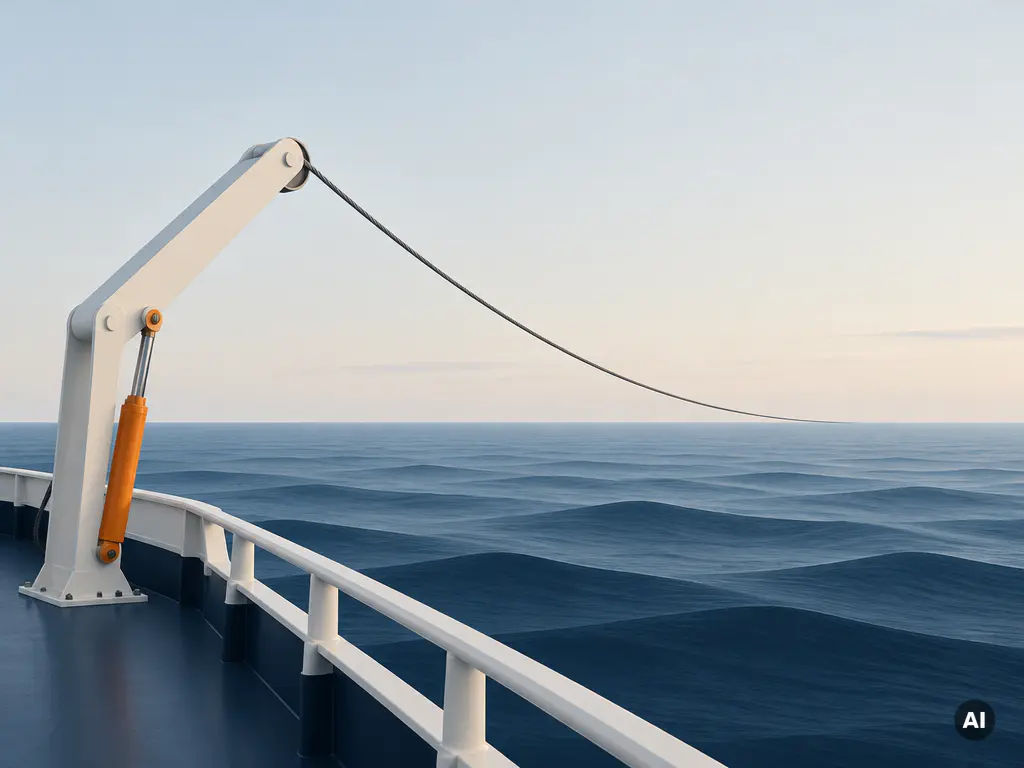
You keep a ship’s cable steady in rough waves by decoupling the cable from the vessel’s motion. A heave compensation system, either passive or active, absorbs or counteracts the vertical movement of the ship, so the cable load stays within a narrow tension range. A constant tension winch, driven by a hydraulic power unit, is the most common way to do this.
The right choice depends on the load, the sea state and how precise the operation must be. Below, we answer the most common questions about cable jerks, snap loads, compensation methods and operating limits, so you can judge which approach fits your hydraulische systemen voor offshore wind or other marine project.
Why does a cable jerk so violently at sea?
A cable jerks at sea because the vessel moves up and down with the waves while the load on the other end does not. This difference in motion constantly changes the cable length between the ship and the load, so tension rises and falls with every wave cycle.
Several factors make this worse in practice:
- Heave, pitch and roll: The ship moves in six degrees of freedom. The attachment point of the cable often sits far from the vessel’s centre of motion, which amplifies the movement the cable sees.
- Wave period: When the wave period approaches the natural frequency of the cable and load system, resonance can increase the load swings.
- Load behaviour: A suspended load can move independently of the ship. A load on the seabed or on a fixed structure does not move at all, which increases the relative motion.
- Cable stiffness: A stiffer cable transmits movement directly into tension. A longer, more elastic cable absorbs some of it, but also stores energy that can release suddenly.
The result is a cable that alternates between high tension and almost no tension. That alternation leads to the most damaging event in marine cable work: the snap load.
What happens when a cable goes slack and snaps tight?
When a cable goes slack and then snaps tight, the sudden re-tensioning creates a snap load. This peak force can be several times higher than the static load, because the moving ship pulls the cable taut faster than the system can accelerate the load.
Snap loads cause damage in several ways:
- Cable fatigue and breakage: Repeated peaks accelerate wear and can exceed the working load limit, even when the static load looks safe.
- Winch and structural overload: Drums, gearboxes, brakes and padeyes see shock loads they were not sized for.
- Loss of control: A slack cable can tangle, jump off a sheave or bird-cage on the drum.
- Safety risk: A snapping cable or a swinging load endangers deck crews and equipment.
The goal of any compensation system is therefore twofold: prevent the cable from going slack, and limit how fast tension can build up again. Keeping tension constant solves both.
How do ships absorb wave movement in a cable?
Ships absorb wave movement in a cable by adding a compliant element between the vessel and the load, or by letting the winch pay out and haul in cable to match the waves. Common solutions include passive compensators, constant tension winches and fully active heave compensation systems.
The main methods work as follows:
- Elastic or damping elements: Springs, shock absorbers and hydraulic cylinders with accumulators let the cable length change without a large force change.
- Constant tension winch: A hydraulic winch holds a set cable tension. When the ship rises, the winch pays out. When the ship drops, it hauls in.
- Motion-compensated crane or gangway: The tip or landing point is stabilised relative to a fixed reference instead of to the moving vessel.
- Heave compensation cylinders: Hydraulic cylinders in the cable path extend and retract to offset vertical movement.
Hydraulics suit this task well because they deliver high force, fast response and smooth control at low speeds. Well-designed hydraulische aandrijf- en besturingssystemen combine pumps, valves, accumulators and electronic control to keep that response stable under changing loads.
How does active heave compensation work?
Active heave compensation works by measuring the vessel’s motion in real time and driving a winch, cylinder or crane in the opposite direction. A motion reference unit sends data to a controller, which commands the hydraulic actuators to cancel the heave so the load stays steady relative to the seabed or a fixed target.
A typical active system has four building blocks:
- Sensors: A motion reference unit (MRU) measures heave, pitch and roll. Load cells or pressure sensors measure cable tension.
- Controller: Software predicts and calculates the required compensating movement and sends control signals to the valves.
- Hydraulic power unit: The hydraulic power unit (also called a hydraulic power pack) supplies flow and pressure on demand, often using variable displacement pumps and accumulators to cover peak power.
- Actuators: Hydraulic motors on a winch drum or hydraulic cylinders move the cable or load to counteract the vessel motion.
Because the system reacts to measured motion, it can achieve high accuracy, even with large vessel movement. The trade-off is higher complexity, higher power demand and a stronger need for reliable sensors, filtration and maintenance. The same principle also supports other offshore equipment, such as a monopile gripper that must keep its position relative to a pile while the vessel moves.
What is the difference between passive and active compensation?
Passive compensation absorbs motion through stored energy, using springs or gas-charged accumulators, without external control. Active compensation uses sensors and powered actuators to cancel motion. Passive systems are simpler and cheaper, while active systems offer higher accuracy and work in a wider range of conditions.
| Aspect | Passive compensation | Active compensation |
|---|---|---|
| Principle | Stored energy in gas or springs absorbs motion | Sensors and actuators counter motion in real time |
| Control | No active control | Electronic control with motion reference |
| Accuracy | Moderate, depends on load and wave period | High, adjusts to changing conditions |
| Power demand | Low | Higher, needs a hydraulic power unit |
| Complexity | Low | Higher, includes software and sensors |
| Typical use | Simple lifts, moderate sea states | Precise placement, sensitive loads, harsher sea states |
Many installations use a hybrid solution: a passive element carries the bulk of the static load, while an active system handles the remaining motion. This reduces the power the hydraulic system must deliver and improves energy efficiency.
How rough is too rough for cable work at sea?
No single wave height applies to every operation. The limit depends on the vessel, the load, the compensation system and the task. Operators define an operational weather window, often based on significant wave height, wave period and wind speed, and stop work when conditions exceed the system’s design limits.
Key factors that set the limit include:
- System design limits: Each winch and compensator is rated for a maximum load, stroke, speed and sea state. Stay within the manufacturer’s documented limits.
- Wave period and direction: Long swell and short, steep waves affect the vessel differently, even at the same wave height.
- Type of operation: Placing a sensitive component near the seabed needs a calmer window than a simple tow or mooring task.
- Stroke and power reserve: If the required compensation stroke or hydraulic power exceeds what the system offers, tension control will fail.
- Condition of the equipment: Worn seals, contaminated oil or weak accumulators reduce response and lower the safe limit.
Plan every operation with a documented risk assessment and agreed stop criteria. Regular inspection, fluid filtration and condition monitoring of the hydraulic system help you trust the compensation system when the weather gets difficult.
Hoe HYCOM hydraulische systemen voor offshore toepassingen ondersteunt
We ontwerpen en bouwen complete hydraulische systemen, inclusief de bijbehorende elektronische besturing, voor offshore toepassingen zoals actieve heave-compensatiesystemen, speciale lieren en schokdempers. Voor jouw toepassing kijken we naar belasting, zeegang en beschikbaar vermogen, en vertalen we dat naar een betrouwbaar systeem.
- Engineering en ontwikkeling van hydraulische aandrijf- en besturingssystemen voor heave compensation en lieren.
- Ontwerp en productie van hydraulic power units en maatwerkoplossingen.
- Levering van hydraulische cilinders, leidingwerk en manifolds als onderdeel van het complete systeem.
- Onderhoud, revisie en reparatie van hydraulische componenten en systemen.
- Technische ondersteuning, installatie, inbedrijfstelling en service, ook na oplevering.
Wil je de betrouwbaarheid van je hydraulische systemen verbeteren, ongeplande stilstand beperken of een nieuwe hydraulische installatie ontwikkelen? Ontdek welke technische oplossingen en diensten aansluiten op jouw toepassing, bijvoorbeeld onderhoud en revisie van hydraulische systemen. We denken graag met je mee over een passende aanpak voor jouw project. Wil je weten wat er mogelijk is? Bespreek jouw hydraulische uitdaging met onze specialisten en plan een technische projectbespreking.