
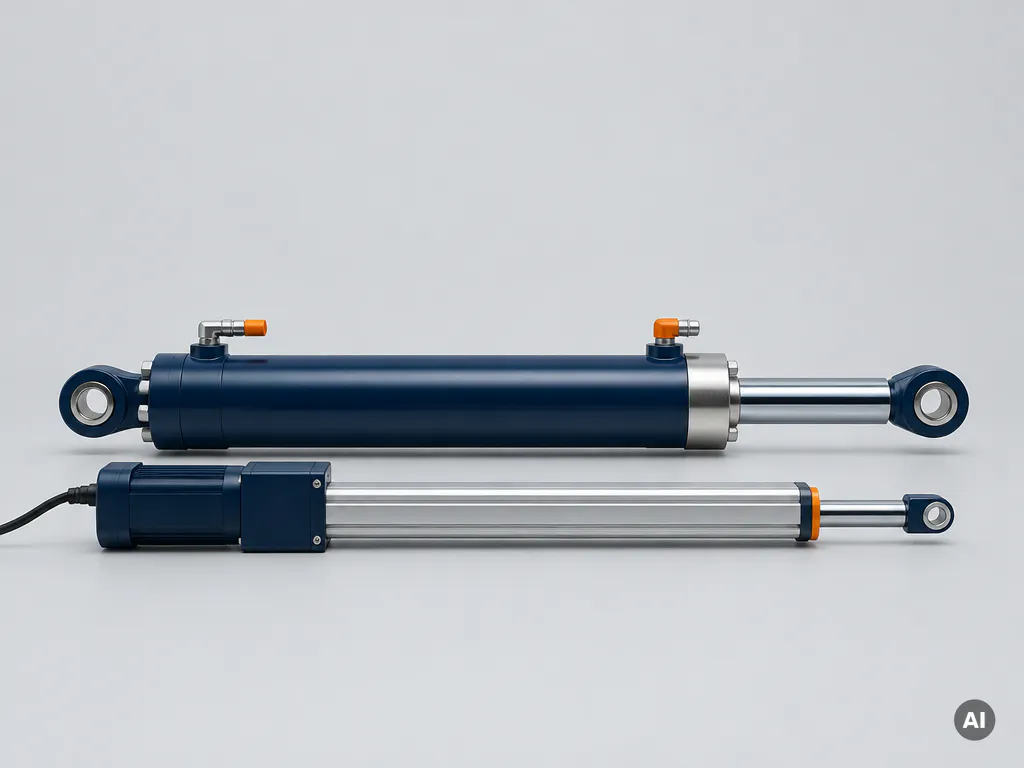
Electric machinery converts electrical energy into motion through motors, gears and screws, while fluid-powered (hydraulic) machinery transmits force through pressurized oil in pumps, valves and cylinders. Hydraulics delivers far higher force density and handles shock loads well. Electric drives offer cleaner installation, higher energy efficiency at partial load and precise positioning. Hieronder lees je hoe beide technieken verschillen in kracht, regeling, onderhoud en toepassing, en wanneer je ze combineert.
Why Do Heavy Machines Still Rely on Fluid Power?
Heavy machines rely on fluid power because hydraulic systems deliver very high force and torque from compact components, tolerate shock loads, and give continuous, stepless speed control. A hydraulic power unit can drive several cylinders and motors at once, which suits machines that work in harsh, wet or dusty environments.
Pressurized oil acts as a flexible power transmission line. A single hydraulic power pack can supply a lifting cylinder, a slewing motor and a winch drive through hoses and manifolds, with the actuators placed where the work happens. Overloads are also easy to manage: a relief valve limits pressure and protects the structure, whereas an electric drive would trip or stall.
This explains why offshore hydraulic systems, dredging vessels and civil structures such as locks and bridges still depend on hydraulische systemen voor offshore wind and related fluid power solutions. These applications combine large forces, long duty cycles and exposure to salt water, vibration and temperature swings.
Which Delivers More Force in a Small Space?
Fluid power delivers more force in a small space. A hydraulic cylinder generates force as pressure multiplied by piston area, so a compact actuator at high system pressure can produce loads that would require a much larger electric motor, gearbox and screw assembly.
Power density is the main reason. Hydraulic components carry a large power output per kilogram and per cubic metre, and the actuator itself does not need to carry a heavy motor. That matters for equipment such as a monopile gripper on an installation vessel, where cylinders must clamp a large steel foundation with high, controlled force, or for lifting systems on jack-up platforms.
Electric actuators can match hydraulic force, but they usually need larger frames, bigger gearing and more mechanical wear parts to do so. At low and medium force, the gap narrows and electric options become competitive. At the heavy end, fluid power keeps a clear lead.
How Do Electric and Fluid Systems Compare on Control?
Electric systems offer very precise positioning and easy digital integration, while hydraulic systems offer smooth, proportional control of force and speed under heavy and changing loads. Modern hydraulics with proportional or servo valves and electronic controllers close much of the precision gap.
The differences show up in practice:
- Position accuracy: Electric servo drives hold position with high repeatability. Hydraulic servo systems reach high accuracy too, but require sensors and well-tuned control loops.
- Load handling: Hydraulics hold a load at standstill without continuous power draw through valves such as load-holding valves. Electric drives usually need a brake or continuous torque.
- Dynamic response: Hydraulic actuators respond quickly under high loads, which is why they are used in motion compensation.
- Tension control: A constant tension winch keeps rope tension within a set range while a vessel moves, and hydraulic drives handle this naturally by regulating pressure.
The same principle supports hydraulic winch systems and active heave compensation, where the drive must absorb continuous wave motion and still control the load. If you want to see how these drives are engineered together with their controls, read more about hydraulische aandrijf- en besturingssystemen.
What Are the Maintenance and Reliability Differences?
Electric drives need less routine maintenance because they have fewer fluid-related parts, while hydraulic systems require attention to oil cleanliness, seals, hoses and filters. Both are reliable when maintained correctly, but hydraulic reliability depends strongly on fluid condition.
Hydraulic maintenance points
Contamination is the main cause of hydraulic component wear, so fluid filtration, oil sampling and condition monitoring have a direct effect on service life. Seals, hoses and pump wear need scheduled inspection. Cylinders and pumps can be overhauled and returned to service, which keeps total cost of ownership manageable on long-life assets.
Electric maintenance points
Electric drives mainly need attention to bearings, cooling, cabling and gearbox lubrication. They avoid leakage risks, which helps in environments where oil release is a concern. When a failure happens, however, replacing a motor or gearbox in a heavy mechanical drive train can be a larger job than servicing a hydraulic component.
For heavy assets, the practical question is which system your team can monitor and repair fastest in the field.
When Does Electric Power Make More Sense?
Electric power makes more sense for lighter loads, precise positioning, clean environments and applications where energy efficiency at partial load and the absence of oil leakage risk outweigh the need for very high force density.
Typical cases include:
- Indoor automation and assembly equipment where leaks are not acceptable.
- Applications with long idle periods, where electric drives consume little energy when not moving.
- Low to medium force positioning tasks with tight accuracy requirements.
- Installations where a hydraulic power unit would add infrastructure that the application does not justify.
Check the full duty cycle before you decide. Energy use, cooling, shock load exposure and expected service life often change the outcome compared with a comparison based on peak force alone.
Can Electric and Fluid Power Work Together in One Machine?
Yes. Electric and fluid power often work together in one machine: electric motors drive the hydraulic pumps, and electronic controllers regulate valves, pump displacement and speed. This combination uses electric control precision together with hydraulic force density.
The most common example is a hydraulic power unit with an electric motor, sometimes fitted with a variable frequency drive. The drive adjusts pump speed to match demand, which cuts energy use compared with a constant-speed setup. Sensors, PLCs and condition monitoring link the hydraulic circuit to the machine control system, so you can follow pressure, temperature and oil cleanliness in real time.
Electro-hydraulic design is therefore usually the practical answer on heavy equipment: electric power supplies and controls the energy, and fluid power delivers the force at the actuator.
Hoe HYCOM hydraulische systemen voor zware toepassingen ondersteunt
Bij HYCOM combineren we hydraulische kracht met geavanceerde elektronische regeling, zodat je de juiste aandrijftechniek krijgt voor jouw toepassing. We helpen je bij de keuze, het ontwerp en het onderhoud van de installatie.
- Engineering en ontwikkeling van hydraulische aandrijf- en besturingssystemen.
- Ontwerp en productie van hydraulische power units en maatwerkoplossingen.
- Hydraulische systemen voor offshore toepassingen, zoals lieren, heave-compensatie en hefinrichtingen.
- Onderhoud, revisie en reparatie van hydraulische cilinders, pompen, motoren en leidingwerk.
- Technische ondersteuning, installatie, inbedrijfstelling en service.
Wil je de betrouwbaarheid van je hydraulische systemen verbeteren, ongeplande stilstand beperken of een nieuwe hydraulische installatie ontwikkelen? Ontdek welke technische oplossingen en diensten aansluiten op jouw toepassing, zoals onderhoud en revisie van hydraulische systemen. We denken graag met je mee over een passende aanpak voor jouw project. Neem contact met ons op en bespreek jouw hydraulische uitdaging met onze specialisten.