
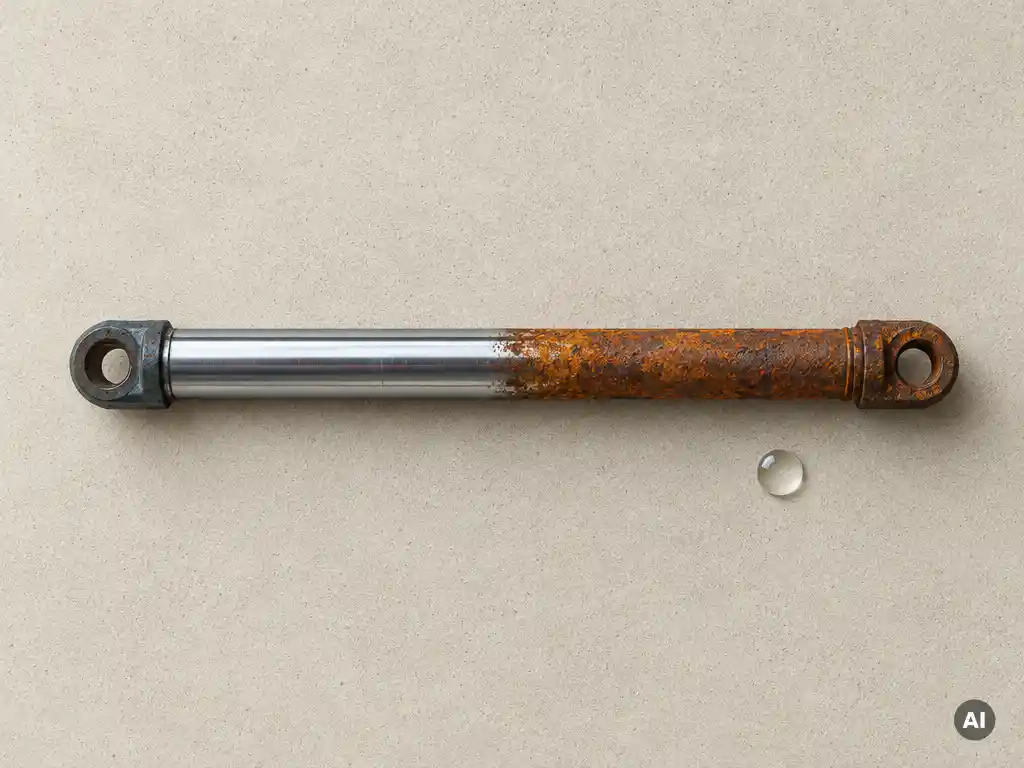
Equipment fails so often in harsh saltwater conditions because chloride ions break down protective films on metal, while humidity, wave action, temperature swings and contamination speed up wear on seals, hoses and moving parts. The result is corrosion, leakage and seizure that no single component can resist alone.
For offshore hydraulic systems, the failure rarely starts with one big event. It builds from small ingress points and surface damage that compound over months. Below, we answer the most common questions about why it happens, how to spot it early and how to design for a longer service life.
What actually happens to metal when salt reaches it?
Salt accelerates corrosion because chloride ions attack the thin oxide layer that normally protects steel and stainless steel. Once that layer breaks, moisture and oxygen reach the bare metal, and electrochemical reactions begin. Saltwater is also a strong electrolyte, so corrosion currents flow far more easily than in fresh water.
Several corrosion mechanisms show up in marine and offshore wind environments:
- Pitting corrosion: Chlorides create small, deep pits, often in stainless steel. Pits are hard to see and can compromise a cylinder rod or a manifold block before the surface looks bad.
- Crevice corrosion: Salt water gets trapped under bolt heads, flanges and clamps, where oxygen runs low and local chemistry turns aggressive.
- Galvanic corrosion: When two different metals touch in a wet, salty environment, the less noble metal corrodes faster. Mixed materials in fittings, brackets and fasteners are common culprits.
- Uniform corrosion: Unprotected carbon steel rusts across its whole surface, thinning wall sections and weakening structures.
Salt also dries into crystalline deposits when spray evaporates. These deposits attract moisture from the air, which keeps the surface wet even on dry days. That is why equipment in a splash zone or on an exposed deck corrodes faster than the same equipment in a sheltered hall.
Why do seals, hoses and moving parts fail first?
Seals, hoses and moving parts fail first because they combine two stresses: they flex, slide or rotate under load, and they sit at the boundary between the hydraulic system and the outside environment. Any damage to a sealing surface or elastomer lets salt in and oil out, which starts a failure chain.
Hydraulic cylinder rods and seals
A cylinder rod passes in and out of the barrel with every stroke. If salt corrodes the chrome layer, the rough surface scrapes the rod seal and wiper. The seal then leaks, and the rod drags salt water back into the cylinder on the return stroke. This is why rod condition is one of the most important points in offshore cylinder reliability.
Hoses, fittings and piping
Hoses suffer from UV exposure, ozone, abrasion and constant movement from vessel motion. Salt deposits under clamps and at crimped fittings promote crevice corrosion and can wick moisture into the hose cover. Hydraulic piping with poor coatings or unsuitable materials corrodes from the outside in, particularly at supports and weld seams.
Winches, pumps and motors
A hydraulic winch or constant tension winch relies on bearings, drum surfaces, brake components and rotating seals. Salt ingress at shaft seals can contaminate bearings and the fluid itself. Water in hydraulic oil reduces lubrication, promotes cavitation damage in pumps and accelerates wear in motors, which shortens overhaul intervals.
Is saltwater the only cause of failure at sea?
No. Saltwater drives corrosion, but offshore failures usually come from a combination of factors. Fluid contamination, vibration, thermal cycling, UV exposure, biofouling, poor coatings and maintenance gaps all contribute. Treating salt as the only cause leads to partial fixes that do not extend service life.
The most relevant additional causes include:
- Fluid contamination: Particles, water and degraded oil damage valves, pumps and servo components. A hydraulic power unit with weak filtration and breathers lets in moisture that corrodes the system from within.
- Dynamic loading: Wave motion, heave and shock loads fatigue welds, mounting points and hose assemblies. Systems such as a monopile gripper or an active heave compensation setup see repeated peak loads.
- Temperature cycling: Daily temperature swings cause condensation inside reservoirs and enclosures, so water enters even without direct spray.
- Coating damage: Impact, abrasion and poor surface preparation create gaps in the paint system. Corrosion then spreads underneath the coating.
- Maintenance intervals: Offshore access is limited and expensive. Components often run past the point where inspection would have caught early damage.
Industry experience shows that most premature failures trace back to a mix of design choices, installation quality and upkeep rather than one root cause.
What are the early warning signs of salt damage?
The earliest warning signs of salt damage are white or brown deposits at joints, blistering or flaking coatings, light weeping at seals and discoloured hydraulic oil. Catching these signs during routine inspections lets you repair or replace parts before leakage or seizure causes unplanned downtime.
Look for these indicators during inspections and condition monitoring:
- Salt crusts and rust staining around fittings, flanges, bolts and clamps.
- Coating blisters, cracks or paint creep at edges and weld seams.
- Pitting or scoring on cylinder rods, particularly near the wiper area.
- Wet or oily films around rod seals, rotary joints and hose connections.
- Cloudy or milky oil in the reservoir, which signals water ingress.
- Rising particle counts or water content in oil analysis.
- Stiff, cracked or swollen hose covers and corroded crimp collars.
- Increased noise, heat or slower response in pumps, motors and valves.
Regular oil sampling gives you an early view of what happens inside the system. Combined with visual inspection of rods, piping and fittings, it helps you plan maintenance instead of reacting to failures.
Can equipment be made to last in salty environments?
Yes. Equipment lasts longer in salty environments when you combine corrosion-resistant materials, protective coatings, effective sealing, clean fluid management and a planned maintenance routine. No single measure is enough, but a well-specified design can run reliably for years in offshore conditions.
Practical measures that make a measurable difference:
- Select suitable materials: Match material grades to the exposure zone. Splash zone equipment needs different specifications than equipment in a sheltered machinery space. Avoid mixing metals that create galvanic couples.
- Use proven coating systems: Surface preparation and coating build quality matter as much as the coating type. Plan touch-up procedures for transport and installation damage.
- Protect rods and sealing surfaces: Use rod coatings suited to marine duty, add bellows or rod protection where possible and choose seal packages designed for wet, contaminated conditions.
- Keep the fluid clean and dry: Fit quality filtration and desiccant or sealed breathers on the reservoir of the hydraulic power pack. Use flushing after repairs and commissioning to remove particles from piping.
- Design for access: Place inspection points, drains and sampling ports where crews can reach them safely.
- Plan overhaul intervals: Schedule cylinder, pump and motor overhaul based on duty cycle and condition data, not only on failure.
Careful design pays back in total cost of ownership. Offshore intervention costs more than the component itself, so avoiding even one unplanned offshore repair often outweighs the extra investment in better materials and protection. For applications like hydraulic systems for offshore wind, this approach protects availability on installation vessels, platforms and foundation equipment. Our experience with hydraulic drive and control systems shows that early alignment between design, coating, filtration and service planning prevents most recurring failures.
Hoe HYCOM hydraulische systemen voor offshore toepassingen ondersteunt
We ontwerpen, bouwen en onderhouden hydraulische systemen voor offshore, offshore wind en baggerwerk. Daarbij houden we rekening met corrosie, vervuiling en wisselende belasting vanaf de eerste ontwerpfase. Zo helpen we je om de levensduur van je installatie te verlengen en storingen op zee te beperken.
- Engineering en ontwikkeling van hydraulische aandrijf- en besturingssystemen voor offshore toepassingen, waaronder hefinrichtingen, active heave compensation en speciale lieren.
- Ontwerp en productie van hydraulic power units en maatwerkoplossingen die passen bij jouw omgeving en dienstcyclus.
- Onderhoud, revisie en reparatie van hydraulische cilinders, pompen, motoren en hydraulisch leidingwerk.
- Optimalisatie van betrouwbaarheid, operationele prestaties en levensduur.
- Technische ondersteuning, installatie, inbedrijfstelling en service.
Wil je de betrouwbaarheid van je hydraulische systemen verbeteren, ongeplande stilstand beperken of een nieuwe hydraulische installatie ontwikkelen? Ontdek welke technische oplossingen en diensten aansluiten op jouw toepassing, zoals onderhoud en revisie van hydraulische systemen. We denken graag met je mee over een passende aanpak voor jouw project. Neem contact op en bespreek jouw hydraulische uitdaging met onze specialisten voor technisch advies of een projectbespreking.