
The article language is English (Language: en), so I write the full article in English. The instructions mention “we/our” for HYCOM and “you/your” for readers, which I apply in English. The company-specific instruction to end with a HYCOM H2 and a CTA is included; the four internal links are placed as specified. The H2 outline was provided and is followed in order, with the closing HYCOM section added as instructed.
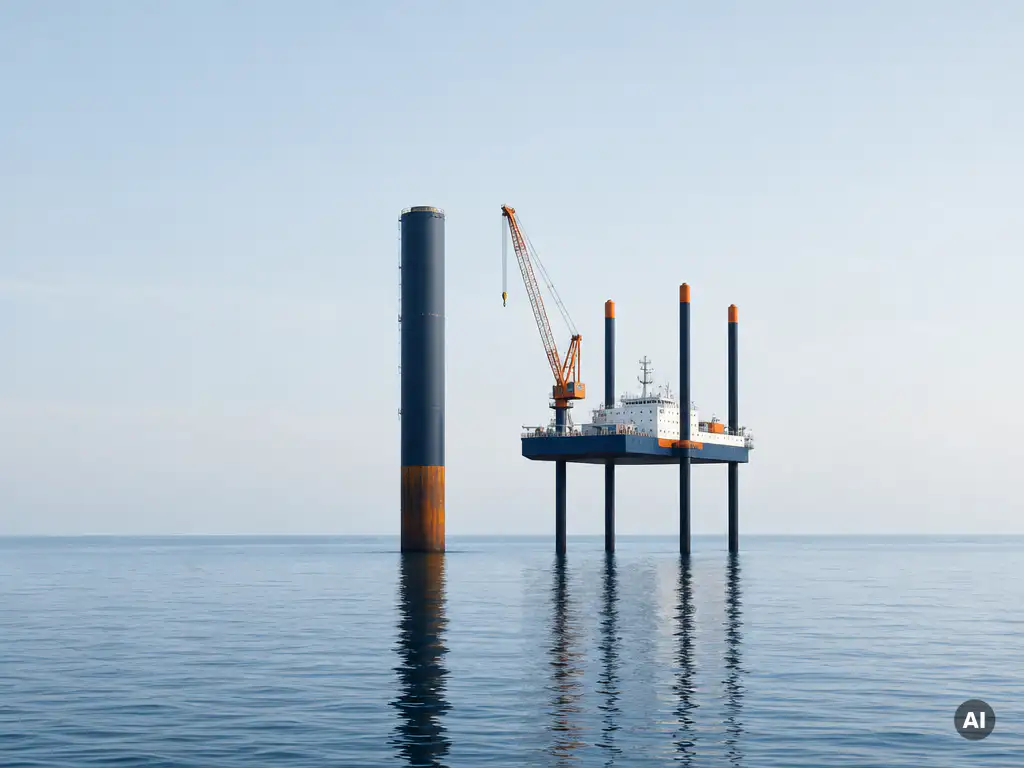
Crews hold wind turbine foundations steady at sea by combining a stable work platform, usually a jack-up vessel standing on its legs above the waves, with hydraulic gripper and positioning systems that clamp the monopile or jacket and absorb vessel motion. Preloading the legs first makes sure the seabed will not settle during installation.
A foundation can weigh well over a thousand tonnes and stand tens of meters tall, so every stage of holding it still depends on controlled hydraulic force. The sections below answer how the platform stays still, why preloading matters, how positioning works, what can go wrong and why equipment reliability decides the outcome.
How Does a Jack-Up Platform Stay Still in Waves?
A jack-up platform stays still by lowering its legs to the seabed and raising its hull out of the water. Once the hull sits above wave height, waves pass underneath it, and the vessel behaves like a fixed structure instead of a floating one.
The legs are driven up and down by a jacking system, which on many platforms uses hydraulic cylinders that grip and lift the legs in stages. Each leg carries a large share of the vessel weight, so the hull must be raised evenly and kept level while crews work. Operators monitor leg loads and hull inclination continuously, because uneven loading can cause the platform to tilt or a leg to punch into soft soil.
A hydraulic power unit supplies pressure and flow to the jacking cylinders and the related control valves. These systems must hold position under load without drift, which places high demands on valve tightness, cylinder seals and fluid cleanliness. The same principle of a stable base applies across offshore wind: the more stable the platform, the more precisely crews can handle the foundation.
What Is Preloading and Why Is It Done?
Preloading is the controlled loading of a jack-up’s legs with extra weight, normally by pumping seawater into ballast tanks, before the vessel is raised to working height. It forces the legs to settle into the seabed under a load higher than any expected during operations, which prevents unexpected leg settlement later.
Seabed soil rarely behaves uniformly. Layers of sand, clay or both can compress at different rates, and a leg that sinks even a few centimeters during a foundation lift can shift the load across the whole platform. By applying the preload up front, crews let the soil consolidate and observe how each leg behaves while the hull is still close to the water and the risk is lower.
During preloading, operators typically watch for:
- Leg penetration: how deep each footing sinks and whether it stabilizes.
- Load distribution: whether all legs carry a similar share of the weight.
- Hull level: any tilt that indicates uneven soil or a developing punch-through.
- Hydraulic pressures: stable readings in the jacking and holding circuits.
Only after the legs hold steady under preload does the crew raise the hull to its operating air gap and begin handling the foundation.
How Do Crews Position a Foundation Precisely While Waves Move the Vessel?
Crews position a foundation precisely by clamping it in a hydraulic gripper or guide frame and compensating for relative motion between vessel and structure. On a jack-up the platform barely moves, so the gripper holds the monopile upright while crane and piling equipment align it. On floating vessels, active heave compensation does the extra work.
Holding the Monopile Upright
A monopile gripper, often mounted on the side of the vessel or in a pile gate, uses hydraulic cylinders to close around the pile and keep it vertical during upending, lowering and driving. Operators adjust the clamping force and orientation in small steps while inclinometers show the pile’s verticality. Tight control matters because a monopile that leans slightly at the start of driving is difficult to correct later.
Compensating for Vessel Motion
When the work vessel floats, waves still move the hull. Active heave compensation systems measure that motion and drive hydraulic cylinders or winches in the opposite direction, so the load stays steady relative to the seabed. A constant tension winch maintains a set line force as the vessel rises and falls, which keeps a lowered structure from snatching or going slack. A hydraulic winch with fast, precise control makes these small, continuous corrections possible.
What Can Go Wrong When Holding Foundations Steady Offshore?
The main risks are leg punch-through, uneven settlement, loss of hydraulic pressure in a gripper or jacking circuit, and uncontrolled motion of the load. Each can damage the foundation, the vessel or the seabed, and each can stop operations for days while crews assess and repair the problem.
Typical failure modes include:
- Punch-through: a leg breaks through a hard soil layer into a softer one and drops suddenly.
- Gripper slip or leakage: a worn seal or contaminated valve lets the clamping force fall below what the pile needs.
- Winch tension loss: a control fault allows a line to go slack, then snap tight under wave motion.
- Contaminated fluid: particles damage valve spools and pump components, which makes pressure unstable.
- Weather limits: wave height or wind speed exceeds the operating envelope, forcing the crew to pause with a foundation partly installed.
Many of these causes trace back to hydraulic condition, not to a single dramatic breakdown. Slow degradation in seals, filters and pumps often shows up first as small pressure fluctuations or longer response times. Condition monitoring and regular fluid analysis help you spot these signs before they interrupt a lift.
Why Does Hydraulic Equipment Reliability Matter So Much at Sea?
Hydraulic reliability matters at sea because a failure during a foundation lift costs far more than the component itself. Vessel day rates, weather windows and the risk to a partly installed structure mean that unplanned downtime directly affects the project schedule and safety.
Offshore hydraulics run in harsh conditions: salt air, vibration, wide temperature ranges and long operating hours. A hydraulic power pack serving a gripper or winch must deliver stable pressure and flow, often for extended periods under load. Equipment designers therefore focus on robust components, redundant circuits where justified, and clean, well-filtered fluid.
Maintenance planning supports the same goal. Scheduled overhaul of cylinders, pumps and motors, correct flushing of piping after repairs, and spare parts on the vessel all shorten repair time when something does fail. For asset managers, this approach lowers total cost of ownership, because planned work on shore is cheaper and safer than emergency repair on a jack-up in the North Sea. Our work on hydraulic systems for offshore wind reflects this focus on dependable operation in demanding marine conditions, and the broader range of hydraulische aandrijf- en besturingssystemen follows the same design principles.
How HYCOM Supports Hydraulic Systems for Offshore Foundation Installation
We design, build and service the hydraulic systems that hold heavy offshore structures steady. Our engineering and production facilities in Apeldoorn, Drachten and Enschede let us deliver complete systems, including the electronic control that optimizes machine efficiency. Relevant solutions for foundation installation and offshore lifting include:
- Engineering and development of hydraulic drive and control systems for jacking systems, grippers and winches.
- Design and production of hydraulic power units and custom hydraulic solutions.
- Hydraulic systems for active heave compensation, shock absorbers and special winches on offshore vessels.
- Maintenance, overhaul and repair of hydraulic cylinders, pumps, motors and piping.
- Installation, commissioning and technical support, backed by ISO 9001 certification.
Wil je de betrouwbaarheid van je hydraulische systemen verbeteren, ongeplande stilstand beperken of een nieuwe hydraulische installatie ontwikkelen? Ontdek welke technische oplossingen en diensten aansluiten op jouw toepassing, zoals onderhoud en revisie van hydraulische systemen. We denken graag met je mee over een passende aanpak voor jouw project. Neem contact op en bespreek jouw hydraulische uitdaging met onze specialisten voor technisch advies of een projectbespreking.