
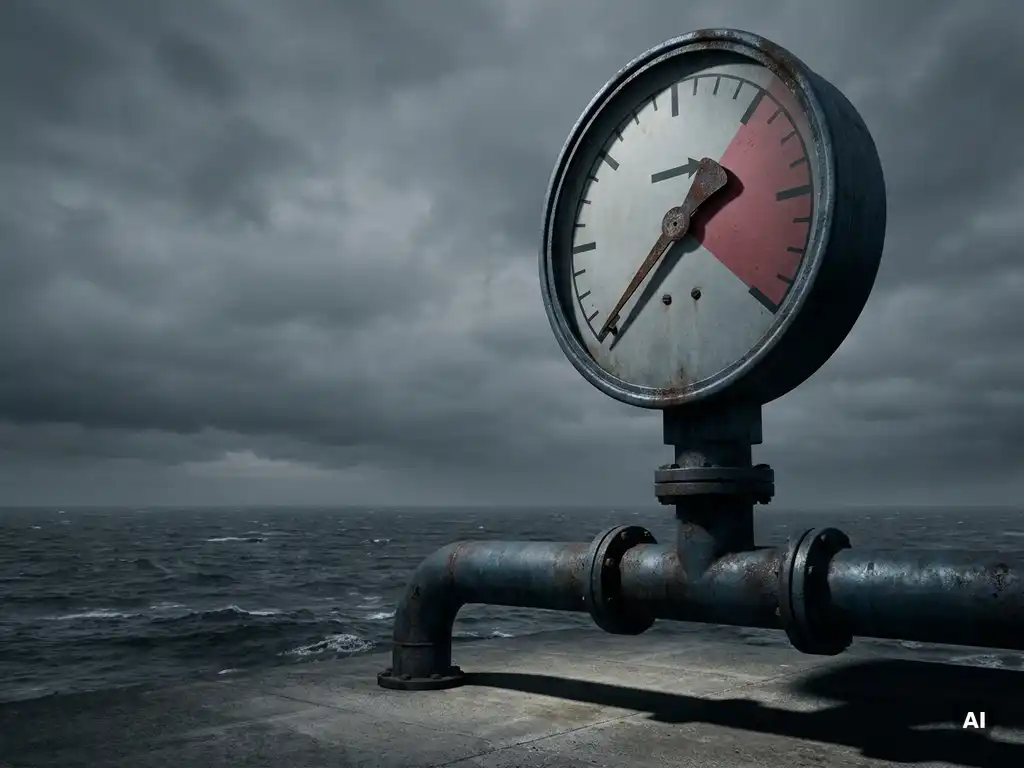
A hydraulic pressure drop during offshore operations most commonly signals a fluid leak, pump wear, or a blocked filter restricting flow through the system. When pressure falls below the operating threshold, actuators lose force, control responses slow down, and in severe cases the entire hydraulic circuit becomes unable to perform its function. The sections below walk through causes, consequences, warning signs, diagnostics, and preventive maintenance for offshore hydraulic systems.
What are the most common causes of hydraulic pressure drops offshore?
The most common causes of hydraulic pressure drops in offshore systems are internal or external fluid leaks, worn or damaged pump components, contaminated or clogged filters, and faulty pressure relief valves that open prematurely. Each of these reduces the ability of the hydraulic power unit to maintain the pressure required for reliable operation.
In the offshore environment, these causes are amplified by conditions that are rarely present onshore. Salt-laden air accelerates corrosion on seals, fittings, and valve bodies. Temperature swings between a cold North Sea night and a warm machinery room cause thermal expansion and contraction that stresses connections and seals over time. Vibration from wave action, deck machinery, and vessel movement loosens fittings and accelerates wear on rotating components inside pumps and motors.
The following causes appear most frequently in offshore hydraulic systems:
- Internal pump leakage: Worn piston shoes, cylinder bores, or valve plates allow fluid to bypass internally, reducing pump output pressure and flow.
- External leaks: Damaged hoses, cracked fittings, or deteriorated seals bleed fluid from the circuit, lowering the volume available to maintain pressure.
- Filter blockage: A clogged suction or return filter starves the pump of fluid or restricts return flow, causing a pressure imbalance across the system.
- Relief valve malfunction: A relief valve set too low, or one that has drifted from its set point, continuously diverts flow back to the tank before operating pressure is reached.
- Air ingestion: Air entering the system through a low reservoir level or a leaking suction line compresses under load, causing pressure fluctuations and cavitation.
- Fluid viscosity changes: Cold hydraulic fluid at startup has higher viscosity, increasing resistance to flow. Conversely, overheated fluid loses viscosity and leaks more readily past internal clearances.
How does a hydraulic pressure drop affect offshore equipment performance?
A hydraulic pressure drop directly reduces the force and speed available to every actuator in the circuit. On offshore equipment, this means hydraulic cylinders extend and retract more slowly, hydraulic winches lose pulling capacity, and control systems become sluggish or unpredictable. In systems where pressure must remain constant to hold a load, even a modest drop can cause uncontrolled movement.
The performance impact depends on how far pressure has fallen and which subsystem is affected. A jacking system on a self-elevating platform requires sustained, high pressure to lift and hold the platform legs against wave and wind loads. If the offshore hydraulic power unit feeding that system drops pressure, the jacking sequence stalls or the holding brakes cannot develop full clamping force. In active heave compensation systems, pressure fluctuations translate directly into positioning errors, reducing the system’s ability to counteract vessel motion accurately.
For marine hydraulic systems controlling watertight doors, bow doors, or movable decks, a pressure drop can prevent doors from sealing fully, creating a safety risk. On cutter suction dredgers and offshore wind installation vessels, hydraulic pressure loss in a monopile gripper or pile-handling tool can interrupt installation sequences and increase the risk of load instability during critical lifting operations.
How quickly can a hydraulic pressure drop lead to system failure offshore?
A hydraulic pressure drop can lead to system failure in minutes if caused by a catastrophic leak or a pump seizure. Gradual causes such as seal wear or filter blockage typically allow hours or days before a system reaches a failure state, provided warning signs are recognised and acted upon. The speed of failure depends on the severity of the root cause and the system’s built-in redundancy.
In practice, offshore systems are often designed with redundant pump circuits or accumulators that can maintain pressure for a defined period after the primary pump fails. An accumulator pre-charged to the correct gas pressure can sustain actuator function long enough to complete a safety-critical movement, such as closing a valve or retracting a cylinder to a safe position. However, if the accumulator pre-charge has degraded or the system has no redundancy, failure can be nearly instantaneous once the pump output drops below the minimum operating pressure.
The risk of rapid failure is highest in systems operating at high continuous loads, such as constant-tension hydraulic winch systems or active heave compensation circuits, because these systems have little tolerance for pressure variation before performance degrades to an unsafe level.
What warning signs indicate a hydraulic pressure problem before failure occurs?
The most reliable early warning signs of a hydraulic pressure problem are abnormal pressure gauge readings, increased cycle times for actuators, unusual noise from the pump or motor, elevated fluid temperature, and visible fluid leaks around fittings or hose connections. Recognising these signs early allows corrective action before a full system failure occurs.
Pressure gauges installed at the pump outlet, at key actuator ports, and across filter housings provide the most direct indication of developing problems. A pressure reading that is consistently lower than the set point, or one that fluctuates irregularly under constant load, points to pump wear, a drifting relief valve, or a leak somewhere in the circuit. A rising differential pressure reading across a filter housing signals that the element is approaching its bypass threshold.
Other warning signs worth monitoring include:
- Cavitation noise: A rattling or knocking sound from the pump indicates air or vapour bubbles are collapsing inside the pump, often caused by a restricted suction line or low fluid level.
- Slow actuator response: Cylinders or motors that move more slowly than normal under the same load suggest reduced pump output or increased internal leakage.
- Fluid discolouration or contamination: Dark, milky, or foamy fluid in the reservoir indicates oxidation, water ingress, or air contamination, all of which affect system pressure stability.
- Increased heat generation: A system working harder to maintain pressure generates more heat. A rising fluid temperature trend without a corresponding increase in workload is a useful diagnostic indicator.
How do offshore engineers diagnose the source of a hydraulic pressure drop?
Offshore engineers diagnose the source of a hydraulic pressure drop by isolating circuit sections, measuring pressure and flow at defined test points, and comparing readings against the system’s design specifications. A systematic approach working from the pump outlet toward the actuators identifies whether the problem originates at the source, in the distribution circuit, or at the point of use.
The diagnostic process typically follows this sequence:
- Check the fluid level and condition: Low reservoir level or contaminated fluid is the simplest cause and the first to rule out.
- Measure pump outlet pressure: Compare the reading against the relief valve set point. If pressure cannot reach the set point under no-load conditions, the pump or relief valve is the likely source.
- Test the relief valve: Temporarily increase the set point slightly while monitoring pressure. If pressure rises, the relief valve was opening prematurely. If it does not, the pump is suspect.
- Perform a pump flow test: Using a flow meter and a load valve, measure pump output flow at rated pressure. A significant drop from the pump’s rated output confirms internal wear or damage.
- Inspect filters and check differential pressure indicators: Blocked filters restrict flow and cause pressure drops downstream. Replace elements and retest.
- Check for external leaks: Inspect all hose connections, cylinder rod seals, and manifold ports under operating pressure for visible fluid loss.
- Test actuator seals: For cylinders, apply pressure to one port while blocking the other and monitor for cross-port leakage, which indicates worn piston seals.
For complex offshore hydraulic power unit installations, condition monitoring systems that continuously log pressure, temperature, and flow data make it possible to identify trends before they develop into failures. This approach is particularly valuable on remote or unmanned offshore assets where manual inspection is infrequent. You can find more detail on system design and integration in our overview of hydraulic systems for offshore wind.
What maintenance practices prevent hydraulic pressure loss in offshore systems?
Preventive maintenance practices that most effectively reduce hydraulic pressure loss in offshore systems include scheduled fluid analysis, regular filter replacement, seal and hose inspection programmes, pump and motor condition checks, and accumulator pre-charge verification. Combining these into a structured maintenance plan reduces the likelihood of pressure-related failures during offshore operations.
Fluid condition is the foundation of hydraulic system reliability. Contaminated or degraded fluid accelerates wear on pump internals, valve spools, and cylinder seals, all of which increase internal leakage and reduce the system’s ability to hold pressure. Regular fluid sampling and analysis, interpreted against ISO cleanliness targets appropriate for the system’s component sensitivity, provide an objective measure of system health between scheduled overhauls.
Filter management is equally important. High-pressure filters, return filters, and suction strainers each protect different parts of the circuit. Replacing filter elements at defined intervals, rather than waiting for bypass indicators to trigger, keeps contamination levels under control. In offshore environments where water contamination is a persistent risk, fitting water-absorbing filter elements or coalescers at appropriate points in the circuit reduces the chance of corrosion and fluid degradation.
For rotating components such as pumps and motors, vibration analysis and temperature monitoring during operation can detect bearing wear and internal clearance changes before they result in reduced output. Coupling this with periodic bench testing of relief valves and pressure-reducing valves ensures that set points remain accurate and that valves do not drift over time due to spring fatigue or contamination.
Accumulator maintenance is often overlooked but directly affects system resilience. A nitrogen pre-charge that has leaked down reduces the accumulator’s ability to buffer pressure spikes and support pressure during brief demand peaks. Checking pre-charge pressure at defined intervals, and recharging or replacing bladders as needed, maintains the accumulator’s contribution to system stability.
Well-maintained hydraulische aandrijf- en besturingssystemen form the operational backbone of offshore assets. Integrating condition monitoring data with maintenance planning allows maintenance managers to shift from reactive repairs toward predictive interventions that reduce unplanned downtime.
How Hycom supports offshore hydraulic system reliability
We design, engineer, and service complete hydraulic systems for the offshore and dredging sectors, with direct experience in the pressure management challenges that offshore operations present. Our work covers the full lifecycle from initial system design through to long-term maintenance and overhaul.
- Engineering and development of hydraulic drive and control systems for offshore applications, including active heave compensation, jacking systems, and constant-tension winch drives.
- Design and production of offshore hydraulic power units and custom HPU solutions, engineered to maintain stable pressure output under the thermal, vibration, and contamination conditions typical of offshore environments.
- Maintenance, overhaul, and repair of hydraulic cylinders, pumps, motors, and complete HPU installations, carried out from our facilities in Apeldoorn, Drachten, and Enschede.
- Condition monitoring and fluid analysis programmes that identify developing pressure problems before they cause unplanned downtime.
- Technical support, installation, and commissioning for new hydraulic systems and upgrades to existing offshore installations.
Wil je de betrouwbaarheid van je hydraulische systemen verbeteren, ongeplande stilstand beperken of een nieuwe hydraulische installatie ontwikkelen? Ontdek welke technische oplossingen en diensten aansluiten op jouw toepassing via onze pagina over onderhoud en revisie van hydraulische systemen. We denken graag met je mee over een passende aanpak voor jouw project. Bespreek jouw hydraulische uitdaging met onze specialisten voor technisch advies of een projectbespreking.